Saturday, December 26, 2015

Antonin Scalia

The following is an email exchange that occurred between Art, Will, Allison, and the group on 14 September 2015.

Antonin Scalia
Art:
Wow, I was actually contemplating the End of Arthur White what with the insanity of the new year and foreseeable future. So fascinating that whenever I've seriously contemplated that something like this happens. Yes, go for it, by all means. Will, I assume you can coordinate that as it develops, right?
Will:
Sure thing..I'll arrange interviews when necessary. Times two on the school year! It's taking a while to get my feet on the ground! I'm sure Liza's struggles are more impressive than ours, and that Allison's potentially lead to higher pay, which makes them more attractive!
I am currently without a school-issued computer, but the recording is a high priority in my life. I'm just dreaming about it more than working on it. For an INTP, dreaming is work. 
Nick is one of Joe's best friends. It's funny how the hole Joe left keeps sucking new people in, and what forms they take, like the clone of Joe Lazarus or the mystery Boston journalist.
Allison:
Indeed, the potential for higher pay makes my struggles incredibly more satisfying. I am keeping up with your emails—though my thoughts are usually full of language that is beyond comprehension for our art. It seems like Farthington writes most law school texts: manifestations of mutual assent? appearance of agency? traditional notions of justice and fair play? antonin scalia? 
I commend all the music making, and think that sharing the process through the blog is such a generous exposure to a process that is usually so full of self-deprecation, or at least, it would be if it be analogously paired with writing. As a person who has zero musical inclination aside from listening to and appreciating a wide variety of music, I hope my lack of contributions recently have allowed the more musical and less philosophical aspects of our art to flourish. 
Balance is something foreign to me except when I'm dancing. 
Law school is treating me justly. There's lots of free food to make up for the pain.
Will:
Free food?!  Nobody told me about the free food when I was picking careers!

Thursday, December 24, 2015

New Development

The following is a Facebook correspondence between Nick and Will from 9 September 2015.

Tom Wolfe
Nick:
Hey Mr. J, how are you doing? I've got a question for you, and an opportunity, I think. In short, I've been trying to crack my way into some form of journalism & I've managed to get a music column at this alt-monthly in Boston and my publisher said it's sort of a local gig but it can be a "you should be listening to this" deal too. And seeing as how I continue and enjoy following Arthur White and the blogs, I thought it might be cool to somehow project Arthur onto a major American city. Let me know what you think—and also, in the spirit of keeping myself busy writing, I'd love to contribute to the blogs if you guys want or need another voice there. Hope everything is going well in Traverse!
Will:
Hey Nick! Thanks for thinking of us! Sounds fantastic! Let me know how you'd like to proceed!
Nick:
You can tell me what you think about this, but my idea was to enter the world of Arthur White as a Tom Wolfe-esque character who emerges with stories about the days he followed them around. The column in Boston would be present-day obviously, but if I were to blog I imagine I would intertwine the philosophical nature of what you guys have already established with a sort of New Journalism style. Journalism of Big Ideas, I guess.
Will:
I love it!
Nick:
Awesome—I'm going to reread some of the blogs today and see if I can't get something going!

Tuesday, December 22, 2015

The Saline Avenger (Part 3 of 3)

The following is an excerpt of an email sent from Will to Art on 20 September 2015.

Arthur and Mordred by William Hatherell

I'm knocked out by all the brilliant stuff!

I've also been prepping for the Kairos retreat I'm directing starting tomorrow. Please forgive my gap in communication!

So, if the vengeful angel is Will's son, we end up with Will as a dark distortion of King Arthur and his bastard son, Mordred?

If we run with a character as disturbing as you've described, I think we would need a figure of a God 's love in the story who reflects the grace of God more strongly than the vengeful angel reflects Puritanical justice.

That character should probably be Arthur, which I think is a tough move for you, given your relationship with the character. I think I've written all of the miraculous stuff into his character, and you've written all of his foibles! In so many ways, you are nicer to Farthington than you are to Arthur, which I get from playing Will. I can put my shortcomings into Will, but I still don't feel like he's that much like me. I'm not entrepreneurial, brash, or patriotic. You may have a little Puritan modesty going on, which might really be self-deprecation, since anything that makes Arthur an impressive figure might be read as a reflection of you.

Monday, December 21, 2015

The Saline Avenger (Part 2 of 3)

The following is an excerpt of an email sent from Art to Will on 18 September 2015.


So I've been wondering: who is the figure that will wreak vengeance on all of us? It can't be Carlton—he's too evil. Maybe suffering the fallout of colonialism would qualify him to play this role, but he's just not innocent enough. I don't think Steffi can do it either.

Then it occurred to me: I want to pattern our vengeful angel on Gianna Jessen. Watch this recent clip of her testifying before Congress.

Burned alive in the womb at 7 months, she survived and now is one of the most terrifying people I have ever heard speak. Regardless of your viewpoints on the topic of abortion, no one can say anything to Gianna Jessen. She has a carte blanche for her entire life. Truth be told, she impresses me as an extremely loving and forgiving person. But who would be more justified in killing everyone than an innocent who was burned alive for 18 hours and survived?

So who would this person be in the narrative? I think I have an idea.

It's Steffi's unborn child who Farthington, as part of his regimen of emptying his novices of all traces of identity, attempts to abort and discard in the tunnels. I'm not sure whose child it is: maybe Will's, maybe Farthington's, maybe someone else's. As we know, Will has gone down into the tunnels to kill Farthington at this point. In the chaos of that encounter, is the baby born alive and left in the tunnels? Who saves the child? I'd like to think it's Steffi, who with her now jawless, speechless mouth, raises the child in darkness.

Now, again, these ideas are all within the puerile Puritan tradition that, like the Socratic Euripides, requires a deus ex machina to resolve the entanglements of the plot. And as I've mentioned before, this kind of approach belies a latent atheism, a disbelief in the omnipotence of God. Thus, we need to help God. Like at the end of Texas Chainsaw Massacre, we have to help a rotting, moribund Grandpa kill Sally with a sledgehammer.

At some point, we should transition into the mature Catholic view, namely, that we don't need a deus ex machina when we have a Deum de Deo, one who gratuitously takes the punishment we deserve. And it is only when we refuse this grace that we implode in on ourselves and suffer the results of our sin: the collapsed reality of hell in which we become next to nothing.

Saturday, December 19, 2015

The Saline Avenger (Part 1 of 3)

The following is an excerpt of an email sent from Art to Will on 18 September 2015.


Jason Voorhees drowns in Crystal Lake

I'm taking notes and then writing when I have a spare moment. This is unrelated to Liza's newest batch of illuminated texts (thanks for keeping the lights on Liza!).

I wanted to take up Will's thread of morality plays.

In particular, I wanted to spend a little time within the American tradition, which is alive and well. In recent years, this tradition has largely taken the form of horror movies.

Unlike Japanese horror, which just involves being in the wrong place at the wrong time, American horror has to do with strict Puritan notions sin and punishment.

Perhaps the best emblem of this tradition is that of Jason Voorhees in the Friday the 13th franchise. Jason, a mentally disabled, deformed child, drowns when two camp counselors go off to have sex. In Friday the 13th, it's Jason's mom who does the killing, but the stage is set for the archetypal vengeful angel who—in his unassailable innocence—returns to punish these transgressions. It's telling that Alice, who fends off the sexual advances of a male camp counselor earlier in the film, is the heroine and only survivor of the first movie (she is summarily dispatched by Jason himself at the beginning of the second).

I don't have the Jung that I've been reading with me, but I love how he issues this total smack down of the Enlightenment and its supposed exorcism of spiritual realities. Modern man is sorely mistaken when he thinks he has exchanged centuries of darkness for the bright light of positivistic, optimistic, empirical thought. All he has done is suppressed the underlying realities, which means they inevitably return, only this time in neurotic or psychotic forms.

I love that Jung explains that the only therapy required for Catholics suffering from modern malaise is to get them connected back up with the Church. The path is much more difficult for Protestants, who initiated the whole de-mystification project culminating in the Enlightenment. Of course, Nietzsche and Wagner and Jung and others had plenty to say in opposition to this wholesale sellout to rationalistic, Apollonian, Alexandrian, Socratic thought, but the celebration has mostly continued unabated down to the present day.

The total banishment of religion from the public square is just one symptom of the larger problem. Again, the Jungian axiom: anything banished returns, only this time in neurotic or psychotic form. What returns feels no guilt. What returns is unabashed, undaunted, intractable, incorrigible. What returns cannot be reasoned with. In the best horror movies, what returns doesn't speak: Jason, Michael Myers, all the various entities in It Follows.

The premise of It Follows is particularly interesting. By having sex with someone you take on the curse: an entity will pursue you at a walking pace until it catches up and brutally mutilates you. This entity is inexorable in its pursuit and invisible to everyone else. Guilt and punishment cannot be mitigated by reference to the consensus loose morality of our times, staying within the brightly lit public square so to speak. Inevitably, you are flushed from your rationalistic hiding place into the dark, inarticulate, isolating, intimate, collapsed world of your guilt.

Long story short, I've been thinking along these lines with regard to the End of Arthur White. If this is a morality tale—and an American morality tale at that—by what instrument, by what mechanism is the justice administered? In Dante, the sin is inextricably bound up in the punishment; there is no separation between the two. This is probably the more accurate, more mature view. But inside the puerile Puritan tradition that is our heritage, we've needed to embody the punishment as something outside ourselves.

I'm thinking of a resolution akin to the one that occurs in Geek Love, where the telekinetic Chick destroys the entire Fabulon camp in a firestorm.

Thursday, December 17, 2015

What the Lord Hath Made Crooked (Part 10 of 10)

The following is a series of attached photos sent from Liza to the group. As usual, we publish typed excerpts of these illuminated texts along with the original photo. The best way is to read the text, of course, is to to experience it in its illuminated form.


Re-reading my letter, I'm reminded of a poster that hung in Will's classroom eight years ago...

I'm having a new memory of my memory; maybe this wasn't a poster but rather a letter →Who Can Make Straight What the Lord Hath Made Crooked? ← This is what that poster said. Most def Ecclesiastes, but maybe not verbatim.

10:18 AM: This was certainly a whiteboard, not a chalkboard.

10:20 AM: The chair looked nothing like this, this is just the image "chair" signifies in my brain. It was taller—a swiveling stool maybe?

10:22 AM: The handwriting was more haphazard; like surgeon scratch.

10:30: When the power of love overcomes the love of power, the world will know peace.←Jimi was somewhere, but not her. Above/on Wall of Fame? Black and white, maybe a postcard—definitely no text.

10:45 AM: On second thought, was the accent wall color burnt pumpkin orange? Wasn't it the adjacent classroom (Mrs. Walker?) that was painted Barney purple?

10:47 AM: "Never wear your best trousers when you go out to fight for freedom and truth"—Henrik Ibsen. ←Sure of the quote, but the placement or the appearance. → Landscape orientation?

11:00 AM: Wasn't this poster up here, too? Landscape orientation?

Certain of dismissal time junior yr: 11:45; senior yr.: 2:45

Friday, December 11, 2015

What the Lord Hath Made Crooked (Part 9 of 10)

The following is a series of attached photos sent from Liza to the group. As usual, we publish typed excerpts of these illuminated texts along with the original photo. The best way is to read the text, of course, is to to experience it in its illuminated form.


"Who can make straight what the Lord hath made crooked."

"You should never wear your best trousers when you go out to fight for freedom and truth."

Wednesday, December 9, 2015

What the Lord Hath Made Crooked (Part 8 of 10)

The following is a series of attached photos sent from Liza to the group. As usual, we publish typed excerpts of these illuminated texts along with the original photo. The best way is to read the text, of course, is to to experience it in its illuminated form.


Why am I sharing this experience with you?

For a variety of reasons. Primarily, though I began this sketch with the intention of reaching concision within my first letter and sending it off to you in sketch-like summation, I continued this sketch with the intention of repeating this exercise with my following classes of the day. And I did. And the results were beyond fascinating and enlightening and enlivening. I believe the will shed a beaming ray of light on the Instagram message thread. Someday soon here.

Over 24 hours later, and I'm still mulling over the said, the unsaid, and the crooked line of inquiry we were collectively left with, none of which could be straightened with clarity.

And I ended my day just as it began: with a vivid memory made clearer only through its pixelation.

Afterall,
answer me this,
Who can make straight what the Lord hath made crooked?

So much for concision,

Liza
September sixteenth,
two thousand and fifteen

Monday, December 7, 2015

What the Lord Hath Made Crooked (Part 7 of 10)

The following is a series of attached photos sent from Liza to the group. As usual, we publish typed excerpts of these illuminated texts along with the original photo. The best way is to read the text, of course, is to to experience it in its illuminated form.


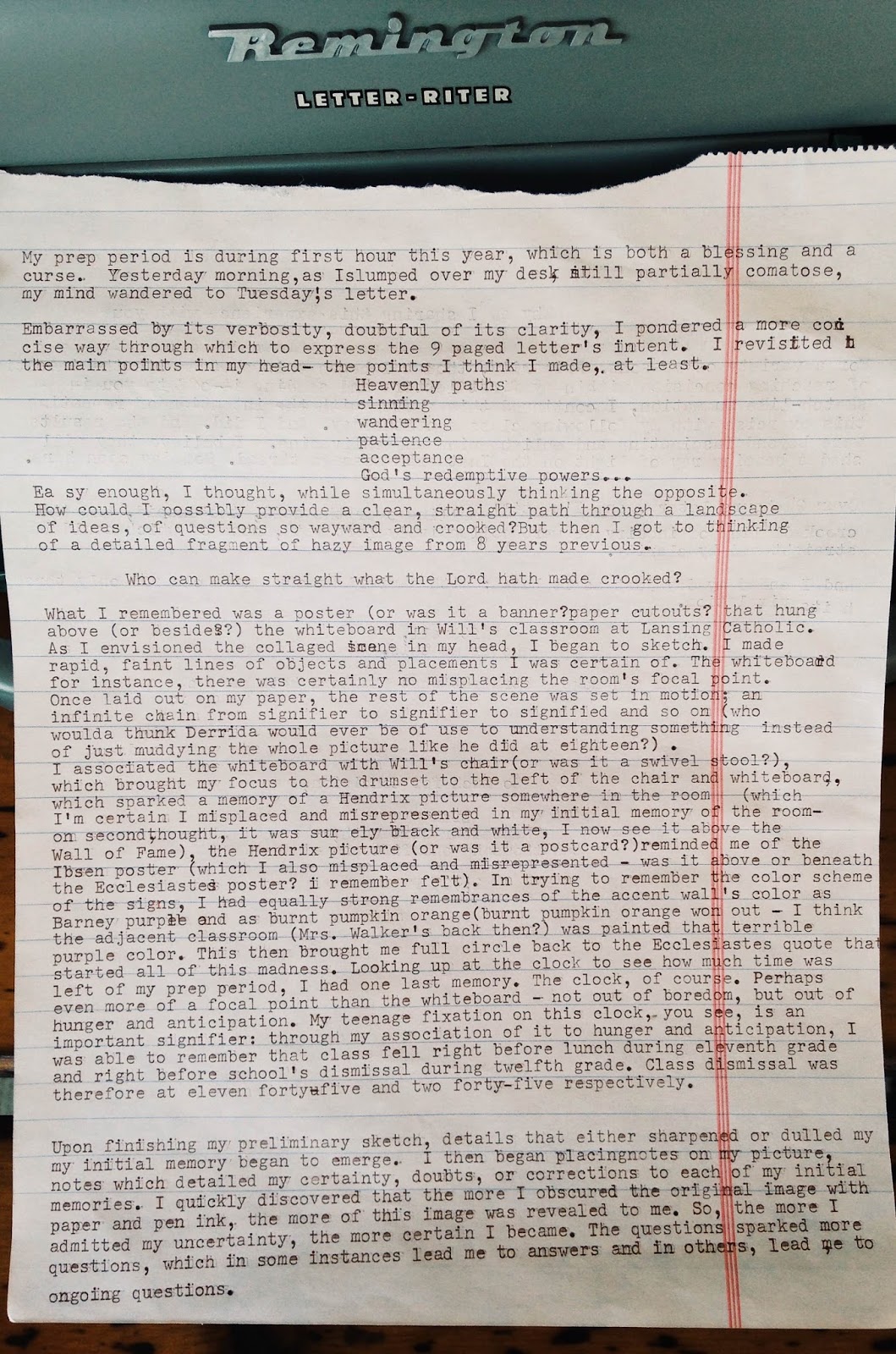
My prep period is during first hour this year, which is both a blessing and a curse. Yesterday morning, as I slumped over my desk, still partially comatose, my mind wandered to Tuesday's letter.

Embarrassed by its verbosity, doubtful of its clarity, I pondered a more concise way through which to express the 9 paged letter's intent. I revisited the main points in my head—the points I think I made, at least.
Heavenly paths
sinning
wandering
patience
acceptance
God's redemptive powers...
Easy enough, I thought, while simultaneously thinking the opposite.
How could I possibly provide a clear, straight path through a landscape of ideas, of questions so wayward and crooked? But then I got to thinking of a detailed fragment of a hazy image from 8 years previous.

Who can make straight what the Lord hath made crooked?

What I remembered was a poster (or was it a banner? paper cutouts? that hung above (or beside?) the whiteboard in Will's classroom at Lansing Catholic. As I envisioned the collaged scene in my head, I began to sketch. I made rapid, faint lines of objects and placements I was certain of. The whiteboard for instance, there was certainly no misplacing of the room's focal point. Once laid out on my paper, the rest of the scene was set in motion; an infinite chain from signifier to signifier to signified and so on (who woulda thunk Derrida would ever be of use to understanding something instead of just muddying the whole picture like he did at eighteen?).

I associated the whiteboard with Will's chair (or was it a swivel stool?), which brought my focus to the drumset to the left of the chair and whiteboard, which sparked a memory of a Hendrix picture somewhere in the room (which I'm certain I misplaced and misrepresented in my initial memory of the room—on second thought, it was surely black and white, I now see it above the Wall of Fame), the Hendrix picture (or was it a postcard?) reminded me of the Ibsen poster (which I also misplaced and misrepresented—was it above or beneath the Ecclesiastes poster? I remember felt). In trying to remember the color scheme of the signs, I had equally strong remembrances of the accent wall's color as Barney purple and as burnt pumpkin orange (burnt pumpkin orange won out—I think the adjacent classroom (Mrs. Walker's back then?) was painted that terrible purple color. This then brought me full circle back to the Ecclesiastes quote that started all of this madness. Looking up at the clock to see how much time was left of my prep period, I had one last memory. The clock, of course. Perhaps even more of a focal point than the whiteboard—not out of boredom, but out of hunger and anticipation. My teenage fixation on this clock, you see, is an important signifier: through my association of it to hunger and anticipation, I was able to remember that class fell right before lunch during eleventh grade and right before school's dismissal during twelfth grade. Class dismissal was therefore at eleven forty-five and two forty-five respectively.

Upon finishing my preliminary sketch, details that either sharpened or dulled my initial memory began to emerge. I then began placing notes on my picture, notes with detailed my certainty, doubts, or corrections to each of my initial memories. I quickly discovered that the more I obscured the original image with paper and pen ink, the more of this image was revealed to me. So, the more I admitted my uncertainty, the more certain I became. The questions sparked more questions, which in some instances led me to answers and in others, led me to ongoing questions.

Friday, December 4, 2015

What the Lord Hath Made Crooked (Part 6 of 10)

The following is a series of attached photos sent from Liza to the group. As usual, we publish typed excerpts of these illuminated texts along with the original photo. The best way is to read the text, of course, is to to experience it in its illuminated form.


Hand cramp. Let's give this beast another college try:
In the following passage, Dorothy is writing in response to discouragement: both that og which she finds roots internally and that which finds roots externally. The only thin is to be oblivious, as Peter is, and go right on. And so on I go...

Upon rationalizing general grievances regarding the cleanliness of the communities served by the Catholic workers, Dorothy suspends (or, perhaps detracts/) her thought. In correction, she writes,

"But what am I talking about? Why am I justifying myself and my family? I am ashamed of myself for getting indignant at such criticism. It just goes to show how much pride and self love I have. But it has been hard lately. Not only outside grumbling, but grumbling from within, the criticism, the complaints, the self doubting and questioning, the insidious discontent spread around by a few *- these trials are hard to bear. However, the thing is to bear these trials, these unavoidable trials. Patiently, to take them lightly, not to let them interfere with the work. The very fact that it is hard shows how weak I am. I should be happy, however, to think that God believes in me strong enough to bear these trials, otherwise I would not be having them. Father Lallemant says that we must beware when things are going too smoothly. That is the time when no progress is made.

Oh dear, I am reminded of St. Teresa, who said, "The devil sends me so offensive a bad spirit of temper that at times I think I could eat people up."
"The best thing for being [discouraged]," replied Merlyn "is to learn something. That is the only thing that never fails you. You may grow old and trembling in your anatomies, you may lie awake at night listening to the disorder of your veins, you may miss your only love, you may see the world around you devastated by evil lunatics, or know your honor trampled in the sewers of baser minds. There is only one thing for it then—to learn. Learn why the world wags and what wags it. That is the only thing which the mind can never exhaust, never alienate, never be tortured by, never fear or distrust, and never dream of regretting. Learning is the thing for you."
- (taking a page out of Art's book) The Once and Future King, T.H. White 

Monday, November 30, 2015

What the Lord Hath Made Crooked (Part 5 of 10)

The following is a series of attached photos sent from Liza to the group. As usual, we publish typed excerpts of these illuminated texts along with the original photo. The best way is to read the text, of course, is to to experience it in its illuminated form.


  1. We liberate these demons through prayer. Andre (and Hasidism) knows whaddup. Prayer can rightfully mean all sorts of things to all sorts of people, of course, but to me prayer is a way of decisive living punctuated by constant inquiry. Am I acting lovingly and gratefully to everything I encounter today? Am I accepting, supportive, and patient in all of my interactions? Am I listening to all that's being communicated with me? Am I trying my best? Am I nurturing the uprooted and nourishing the firmly planted? Am I living the truth? In asking ourselves these questions and, ultimately, in being on the side of light and life, we are actively fighting our demons and offering a hand to our brothers and sisters in fighting their own. For what these demons desire and require from us in order to thrive is first and foremost oblivion. In resisting detection, it's unlikely to be challenged. If detected, the demon's aim is to lure us into a spiritual state so despondent that we stop seeing ourselves as the mystical body of Christ and instead see ourselves as in the image and likeness of the devil.
  1. (Excuse my wonky numbering) However! to look upon this horror and utilize our repulsion to propel us closer to God is the most brutal form of attack against this demonic presence. And because I can't possibly stress it enough, the way in which we utilize this repulsion is through daily positive intent, humility, determination, patience, love, and personified prayer. Each failure to extend these virtues into our daily interactions is, of course, a victory for the devil, but each of these victories is squandered when reconfigured as a breadcrumb like blessing that guides us back to our path. I say (wrote) "All our lives it will be like this" because there is no earthly end; in place of an ending there are only endless opportunities for new beginnings. Cast off your disdain and you'll see that it's not the end, but only a disguise for a welcoming celebration (Rumi). We must, again, remember that life is a procession, that "to be" is "to grow," and the only way to grow (toward heaven) is to remain on our path or be in the process of making it back to the path. We are of one phase and of all phases. Evil propels us and reform of evil desire propels us.
  2. God does not expect, nor does He desire, for us to come to Him with the answers. He merely asks for us to make ourselves worthy of receiving them someday by living our lives as learners, not as knowers. It's here that we again get a glimpse into the understanding that every struggle and failure is indeed a blessing. Our weaknesses, our sufferings, our impatience, our wandering—these are each, in their own little ways, our teachers, our guides from beyond. It's my belief that we make ourselves worthy not in a solemn and steady procession toward death, but rather in a joyful and hopeful procession through death. It's only in dying in this life that we can ever hope to find eternal life in the next one.
  3. I've a letter's length to expound on "bringing religion to schools."
That, and more, up next! Liza

My barn having burned down, I can now see the moon." - Mizuta Masahide

Saturday, November 28, 2015

What the Lord Hath Made Crooked (Part 4 of 10)

The following is a series of attached photos sent from Liza to the group. As usual, we publish typed excerpts of these illuminated texts along with the original photo. The best way is to read the text, of course, is to to experience it in its illuminated form.


  1. Onward to my next miscommunication. I did NOT in fact interpret "devil" to mean "enemy." Not by any means. I understand the demons of which you speak. I was merely trying to outline the preliminary steps in combating them: recognizability of their pervasiveness, perspective, patience, and love. Step 1, as I mentioned, is to recognize them in others. In recognizing them, my suggestion was to love these people nonetheless. The implication in my last letter was not that our enemies are the demons; I rather meant to imply the fluidity spectrum of ethical existence, as well as to bring light to the inherent connection weaving its way beneath us, above us, and through us on a constant loop. It's through this understanding that I AM HE AS YOU ARE HE AS YOU ARE ME AND WE ARE ALL TOGETHER that we're able to humanize and love even the most corrupt and brutally inhumane. It's through this understanding that we take collective responsibility over our actions and our brothers'/sisters' actions with equal investment. Whether young or old, moral or immoral, beautiful or ugly, kind or cruel, intelligent or vapid, we must not only recognize the divine in our earthy brothers and sisters, but it's paramount that our simultaneous gaze is on the demonic and mortal within them, as well. This, of course, extends to ourselves, too. (Note: back to Ubuntuism). EVERY ATOM BELONGING TO OURSELVES AS GOOD, AS BAD BELONGS TO ALL OF US. THE HAND OF GOD IS THE PROMISE OF OUR OWN. THE SPIRIT OF GOD IS THE SPIRIT OF OUR OWN. ALL THE MEN EVER BORN ARE ALSO MY BROTHERS, AND THE WOMEN MY SISTERS AND LOVERS. AND THAT IS KELSON OF CREATION IS LOVE.
  2. It's through Whitman's lens that our eyes may reveal to our hearts the understanding not only to guide us back toward our path but to become agents of guidance ourselves for the least of our brothers and sisters who mistook the earthly path we've paved ourselves with gold for the heavenly path that's been paved through the dirt for us from above.
  3. Art, you mentioned in your last e-mail that the souls of Trump and Gilber are still in play, though you were referencing actual demons. The point I was attempting to make in my last letter and am now attempting to clarify in this letter is that these two, to me, are interchangeable; their souls have been darkened by this irredeemable devil you've referenced. Gilbert (so all of us) darkness, for instance, is personified by the presence of this inner-demon. Whether he surrendered the battle long ago from exhaustion, or whether he's been oblivious of its presence from the beginning, it's clear that Gilber does not have control over his demonic side. Rather, he is controlled by it. It's my understanding that we all have some sort of negative spirit or demon within us. (Side note: Have any of you read Martin Buber's On Hasidism and/or seen My Dinner with Andre? There's this point in the dinner conversation when Wally's just described acting alongside a Czech in a previous play. He explains the reverence with which this actor viewed the performance, as if it were a sacred event. This reverence extended past his individual role in the play, extending itself in the form of respect to each of his fellow actors. Andre, Wally's sole dinner companion, interjects and lays on the Buber: He relates this Czech man's personhood to the Hasidic idea that every moment is to be sacramentalized. You see, the Hasidics believe that there are spirits chained in everything. In you, in me, in the inanimate objects surrounding us. The act of praying, Buber writes (and Andre says), is how we liberate these spirits. This, Andre suggests, is why every action of ours ought to be lived as a prayer, a joyful sacrament. Andre opines this is an uncommon way of living because abstaining from such mindfulness is how we cope with our realities in the world, he says and I agree, that were most of us to confront our actions, we'd find our existences far too nauseating to endure.)

Friday, November 27, 2015

What the Lord Hath Made Crooked (Part 3 of 10)

The following is a series of attached photos sent from Liza to the group. As usual, we publish typed excerpts of these illuminated texts along with the original photo. The best way is to read the text, of course, is to to experience it in its illuminated form.


  1. (Continued) You yearn for brotherly, for sisterly love. You yearn to love others and you yearn to fulfill your earthly potential, seeing it for what it truly is: a gift from the heavens. To yearn for these things, no matter at the moment, signifies, to me, that your path remains illuminated through your unrelenting faith. Having seen the path so clearly at all, you suffer from anguish each time you realize your actions, thoughts, as well as the corrective actions and thoughts of humanity, have again lead you and all of us away from it. (note: revisit Ubuntuism in next letter--"I am because you are.") I think the foundation and frequency of your self-judgments reveal how deeply your faith has seeped into your essence. To exist as a Catholic is to follow the rules through your actions because that's what you're told to do. Generally, these existences are founded and dictated on guilt, fear, and obligation; their existence as Catholics preceded their essence as Catholics. To be Catholic in essence (correction: your faith hasn't "seeped into your essence," it is your essence) is to organize your very being not around these "rules," but through them through you. It is to feel your faith, not just act out your faith. It is to suffer with mind, body, soul, to feel the failure so deeply that it becomes a part of you. This is a tremendous blessing, you see, but it is and can only remain a fruitful blessing when balanced with the following understanding: habitual failing does not define us as permanent failures. We must love both ourselves and one another in our successes and most importantly we must love both ourselves and one another through our failures. We must be kind; we must be patient. Though it's of great importance that we're always aligned with our path or in the process of making our way back toward it, it's perhaps of even greater importance that we acknowledge the impracticality of never stumbling at from it all. This sounds like a lazy and self-interested approach to personifying our faith, yes, but once again I will ask you to exercise your patience with me as I sift through this rubble I've created in search of a treasure worth sharing.
  2. We must strive for perfection with all of our body and all of our soul, but we must do this with the understanding that we will never reach perfection on this earth. What is life if not a journey toward perfection? Take the Sanskrit root for "to be" for instance. bhū́ → भू. Did you know it's the same as the root of "to grow" and "to dwell on Earth (not in Heaven)"? Did you know that's the meaning of this life? I can't stress enough how much this being human is a process, and a trying one at that. Each of us is no more than a work in progress, or as my boy Rumi says, a guest house. And, like that, I've found my next point or rather it's found me. Why I say your faith is "unrelenting." Why I say you've seen the face of God and now you must live in separation from it.
  3. So these "failures" to be patient, loving, and kind are agents of personal (and collective) growth. They're in our lives to illuminate our routes back to our paths. To revisit Rumi once more, EACH OF THESE FAILURES HAS BEEN SENT AS A GUIDE FROM BEYOND! Entertain them all. I was by NO means referring to you as a conservative, Art. Nor was I referring to myself as a radical. I found the essays meaningful, and thought they related nicely to something or other at the time. Sorry for the miscommunication though it seems as though you ultimately benefited from it by replacing the presumed periods with open-ended question marks. In Neil Postman's Teaching as a Subversive Activity (Have you read/re-read it yet, Will?), he writes of how we all enter school as question marks and leave school as periods. I both love and despise this observation and it's through this love and through this hate that I welcome any moment that stirs us from the tranquil comfort of the period of thinking we have tried the answers. There's a danger in comfort→danja, danja, high voltage!

Thursday, November 26, 2015

What the Lord Hath Made Crooked (Part 2 of 10)

The following is a series of attached photos sent from Liza to the group. As usual, we publish typed excerpts of these illuminated texts along with the original photo. The best way is to read the text, of course, is to to experience it in its illuminated form.


  1. But, of course, we frequently feel called to explain our beliefs, for we exist in a civilization in which existence is characterized by disbelief, skepticism, cynicism, ironic self-detachment, and so on. To that, I write this: To believe in something fiercely enough to defend it in the face of persecution, laughter, and cruel judgment is half the battle's triumph already. But that's only the good news. The terrible, horrible, no good, very bad news is that the other half of the battle is far more grueling; this half will be plagued by constant failure, punctuated with frequent doubts, and will wound us beyond recognition. It's this half of the battle in which we must transmute our internal into the external realities of our day to day lives.
  2. Let's lighten the tone a bit, shall we? Moving onto this next Roman numerated point hints at progress already, though not because the murky waters are behind us. Rather because the murky waters are all around us, yet here we still are paddling on nonetheless. We've not yet drowned, and I assure you of our safety in staying afloat as long as we each remember: none of us are perfect, nor will we ever be.
  3. There will, of course, be many times in which our actions veer from the path made straight by our beliefs. And Art, you're absolutely right. Burning bridges, habitual impatience, the inability to personify the values our beliefs set forth for us are all, indeed, wayward of our path. However, I included the "Life in the Womb" excerpt in my last note in hopes of emphasizing this point exactly. (key words: in hopes). Yes. We will fail my friends. Yes, at times we will act in discordance with our beliefs. Yes, we will most certainly sin during this lifetime despite our greatest efforts not to. Yet, what matters most, we must try all the same. In remembering our earthly imperfections, we must renew our hope through the understanding that we will never fail nor fall to depths too deep to ascend. The path will always be waiting to welcome us back to our motorized home upon it, so long as our beliefs resist eviction from their permanent home within.
  4. I can't stress enough how much this being human is a process, and a trying one at that. Each of us is no more than a work in progress, or as my boy Rumi says, a guest house. And, like that, I've found my next point or rather it's found me. Why I say your faith is "unrelenting." Why I say you've seen the face of God and now you must live in separation from it.
  5. I say the above no because in O'Connor's words you "lead a holy life." I say this instead to highlight how cognizant you are that you do not. You don't claim to be a saint. You remain grounded in humility because you recognize the struggles. And what is more, you recognize the frequent failures within these struggles. I say this because you see your failures as failures and you yearn to make them right. You yearn for God's love.
In Atlas's globe: 
    Every morning a new arrival. A joy, a meanness, some momentary awareness comes as an unexpected visitor. Welcome and entertain them all! Even if they are a crowd of sorrows who violently sweep your house empty of its furniture, still treat each guest honorably.

Wednesday, November 25, 2015

What the Lord Hath Made Crooked (Part 1 of 10)

The following is a series of attached photos sent from Liza to the group. As usual, we publish typed excerpts of these illuminated texts along with the original photo. The best way is to read the text, of course, is to to experience it in its illuminated form.


  1. I keep a notebook with me at all times. I keep it close for a variety of reasons, but mostly I carry it with me so that I may be all the more able to immerse myself in moments through momentary separation from them. Understanding comes most freely to me when I participate through observance, which means my writing process can most accurately be described as a whirlwind of quick scrawls and a headache of long decodings once my notebooks have been filled. I tell you this only to document the end of my Keweenaw notebook, and in documenting its ending shine a ray of light onto this letter's beginning. For upon browsing through my notebook this morning, I noticed that 8 of its pages are filled with wayward trains of thought that are each, in their own disconnected ways, fragmented responses to your most recent messages. Another discovery of note: I return to school, both as student and teacher in 7 days. On this discovery I'll not now elaborate, for I know all to well my teardrops' effects on black fountain pen ink.
  2. I preface (begin?) my letter this way as I currently sit sagging in a haze of confusion, dread, and discouragement, etc. etc. How to impose linear order on my notebook's web of chaos? How to make a peaceful exodus from the stillness of the inner garden and imminently reacclimate to the surrounding distractions and mechanical realities of life in Detroit? How am I to be a creative agent, to resist adaptation to this environment in favor of changing it? (More on this artivism + Louise Glück's poetry in my next letter)
  3. Secondary (or perhaps tertiary) explanation for divulging this information: clarification only comes through explanation, communication, conversation, and expression. The advice I most frequently share with my students is to pick up the nearest utensil, put it to the nearest (*appropriate) surface, and see what happens. "There's no wrong way to make," I say. So, I suppose I'll take my own advice now and begin writing to see what I make. I suppose I've already begun.
  4. Regarding an explanation or a rationalization for belief: I think it's perfectly acceptable to believe in our feelings, bankrupt of reasoning as they may be; an inability to articulate our reasoning does not cheapen our beliefs, but in effect strengthens them. I frequently can't transmute my feelings into thoughts & I've slowly learned it's often best this way. To me, these feelings that can't be explained away  are those rooted deepest in our souls and therefore those requiring least explanation. Why? The language of the soul is spoken in a tongue indecipherable to the mind, untranslatable to words even.

Sunday, November 15, 2015

Read First

The following is a series of attached photos sent from Liza to the group. As usual, we publish typed excerpts of these illuminated texts along with  the original photo. The best way to read the text, of course, is to to experience it in its illuminated form.


This letter has been finished since the first week in September, but the return to school has put a lull in the finishing touches I wanted to put on it prior to sending it off.

Finishing touches = COLOR HIGHLIGHT & SKETCH SHARPENING. The important stuff.

Last night, while beginning a new letter in response to these most recent e-mails, I wrote briefly about the WABI-SABI aesthetic in the context of technological detoxes, or sabbaths as they've come to be call. Wabi-sabi = in short, the Japanese art of flawed beauty, simplicity, nature's profundity. There I sat at my desk—anxious at best, stressed at worst—beginning a new letter before finishing the previous letter. Anxious and stressed, that is, until my questioning illuminated the answer at the heart of ZEN = ZAZEN.

I've decided to bring these principles to my letter writing predicament. Though far from finished in design and though I feel physical pain at the thought of sharing something pre-completion and pre-manifestation of vision, I am sharing it all the same.

Such is the wabi-sabi way, finding beauty in the imperfect, the impermanent, the incomplete.

Microcosmic of the transiency of this whole being human thing and frequently mentioned in this second most recent letter, I now grant you permission to have a fragmentary glimpse at something long after it was finished for you but far before it was ready for you.

Squirming in unease though I grow nonetheless,

Liza

P.S. I'm feeling increasingly squirmish at the thought of not adding color to this note, or of not erasing my pencil marks, at not finishing my drawing. The struggle is reality.

Thursday, November 12, 2015

2-Year Plan

The following is an excerpt from an email sent from Art to Will on 7 September 2015.


I do think I came up with something for "Old Habits Die Hard." If you can, send me the lyrics again and I should be able to put it together.

My year is shaping up to be quite a bit busier than expected. I wanted to float the following idea: start the recording July 4, 2016. Have someone take high contrast black-and-white photos, film everything. In short, get as many artifacts out of it as possible.

I want our core group to be totally ready to play the songs well at that point. I may want to just use what I've recorded on keyboard as a spine and have you guys record your parts, then me come in and do the vocals.

At any rate, that's not the main point. The main point is that I don't want what we do next year to be the finished product. I want to take that raw recording and meditate on it for the following year. Then, I'd like to find the remaining pieces and return to the studio in summer 2017. At that point, we'd have identified lead guitarists, background vocalists, keyboardists, horn sections, etc. to add the finishing touches.

Now, we could put out whatever we do summer 2016, saying it was the raw unfinished takes from that Joe Lazarus collaboration--the Joe Lazarus tapes. And now, with the permission of the Arthur White estate and/or Joseph Lazarus III, we're trying to fully realize those recordings. Actually, that might facilitate some actual participation via the blog and social media--inviting feedback, suggestions. Would-be collaborators could upload videos of guitar solos, etc.

So I'm liking that 2-year plan, and now that I'm thinking about it, it might be a perfect opportunity to finally allow our audiences to participate in something: the 2016-to-2017 process of working up the songs.

And maybe we could use that as a way to earn some money for that next session. Make it available on Bandcamp for "whatever you want to pay" and by buying the 2016 tracks on Bandcamp, you've preordered your copy of the 2017 album.

Wednesday, November 11, 2015

Old Habits Die Hard

The following is an excerpt of an email sent from Will to the group on 7 September 2015.

Alexander Fraser Tytler, Lord Woodhouselee, 10 May 1813
Here are the words to "Old Habits."

As always, feel free to change them. The only thing essential to the song is the idea that the song is cyclical--it needs to end where it begins. I can't remember if I told you, but it seems especially fitting now--the lyrics are based on a chain email that went around a lot during the Bush years. I'm not sure why it's less popular under Obama, but I'm sure it's his fault. Thanks, Obama.

Anyway, it's based on a cool theory that has been misattributed since the days of print. I've attached a Snopes article on it; they seem to have cut their research into the history of the piece's publication beyond the last few decades. It seems fitting in the context of the album and the project that the song features the wisdom of a made-up person that has been passed down for at least two hundred years without ever properly citing any sources. Ostensibly, it gets passed down because people remember that one newspaper article they read, which turns into that one radio story they heard, which becomes that one magazine article they can't find, etc. Maybe Slender Man wrote it originally.

Here's another exposé with more of the older history.

Old Habits Die Hard

Slaves to desire
We lost our way
Til we found faith
Began to pray
Found the strength
To break free
Forged a path
Of liberty
Grew our home
Our way of life
Forgot the days
Of pain and strife
When others fell
We let them be
They didn’t work
As hard as we

Old habits die hard
Old habits die hard

And then the bills
Kept rolling in
We’d lost our sense
Of discipline
We looked for help
At any price
Easily
Absorbed advice

Old habits die hard
Old habits die hard

For anything
We’d get for free
Relinquished our
Autonomy
Slaves to desire
We lost our way
Til we found faith
Began to pray

Old habits die hard. x 4

Monday, November 9, 2015

We Go Medieval on the Seventies

The following is an excerpt of an email sent from Will to the group on 4 September 2015.


Detail of The Last Judgment by Hieronymus Bosch

Okay, I think what you've clarified is the intuitive leap we made a while ago between the cults of the seventies and the digital age.

Both speak to the spiritual needs of a culture that has lost God. Farthington is more of a song-and-dance man, an Oz who points people to something larger than himself that isn't really God. He's also a Vernean scientist, though, leading people on wild rides toward proof of something greater than man.

Steffi Humboldt (I just mistyped it Hymboldt!) is basically the digital age. She not only "gets in front of" where Farthington chases (although he chases to get in front of great catastrophes, mainly to be the authority on them), but in our vision of the feminist totalitarian warlord she becomes one with the satellite and absorbs all data into herself, which perhaps makes her the whore of Babylon.

We also have the Benefactor, who doesn't take vacation photos even though she oversees Detroit/America's rise and fall and who ultimately recognizes she must have a showdown with Steffi and lose, kind of like Beowulf vs. The Red Dragon except the dragon doesn't die...it absorbs Beowulf's power. Here we have McLuhan's idea that the global village recalls the patterns of paganism, which I think is the lens through which he read Nietzsche. I remember some outburst of his in which it dawned on him that Nietzsche's "God is dead" refers to the Newtonian god of "everything in its proper place."

Speaking of proper place, McLuhan would agree with Baudrillard that we retreat to the comfort of bonanzaland rather than live in our own age, but I don't think that's what we're up to. The only part of our project that sentimentalizes the seventies is the music, and I am not using sentimentalizes pejoratively here. I love seventies music unabashedly and you know how much sheer joy I get out of trying to play the difference between a 1974 song and a 1975 song...I'm like a kid in a candy store.

But outside of that very necessary indulgence, we are upending everything else that is warm and fuzzy about the past. In our own way, we've gone medieval on the seventies, like a Bosch painting! Our seventies slouches toward Bethlehem and eviscerates American history and the digital age through the tale of the lodestone. The only comfy place we're offering in our upcoming efforts is the album, and it's hard to call an album of prophecies calming. In fact, the prospect of a Trump presidency is making "Hey Rome" feel especially prescient, like we are this close to the lodestone revealing America for what we are. I'm tempted to vote for him, except that I'd feel like Judas, who may have betrayed Christ to see Him manifest his power.

At any rate, I also remember McLuhan saying he has no point of view because electronic culture made being grounded impossible, which is why our project examines from all viewpoints and resists just being a book or a musical or a series or even just being written. It's why it can be an 18th-century autopsy of 20th- and 21st-century culture, and my favorite, a 14th-century morality play with a postmodern take on memento mori.

Friday, November 6, 2015

Geographically Confused

The following is an attachment sent from Liza to the group on 4 September 2015.