Showing posts with label derrida. Show all posts

Monday, December 7, 2015

What the Lord Hath Made Crooked (Part 7 of 10)

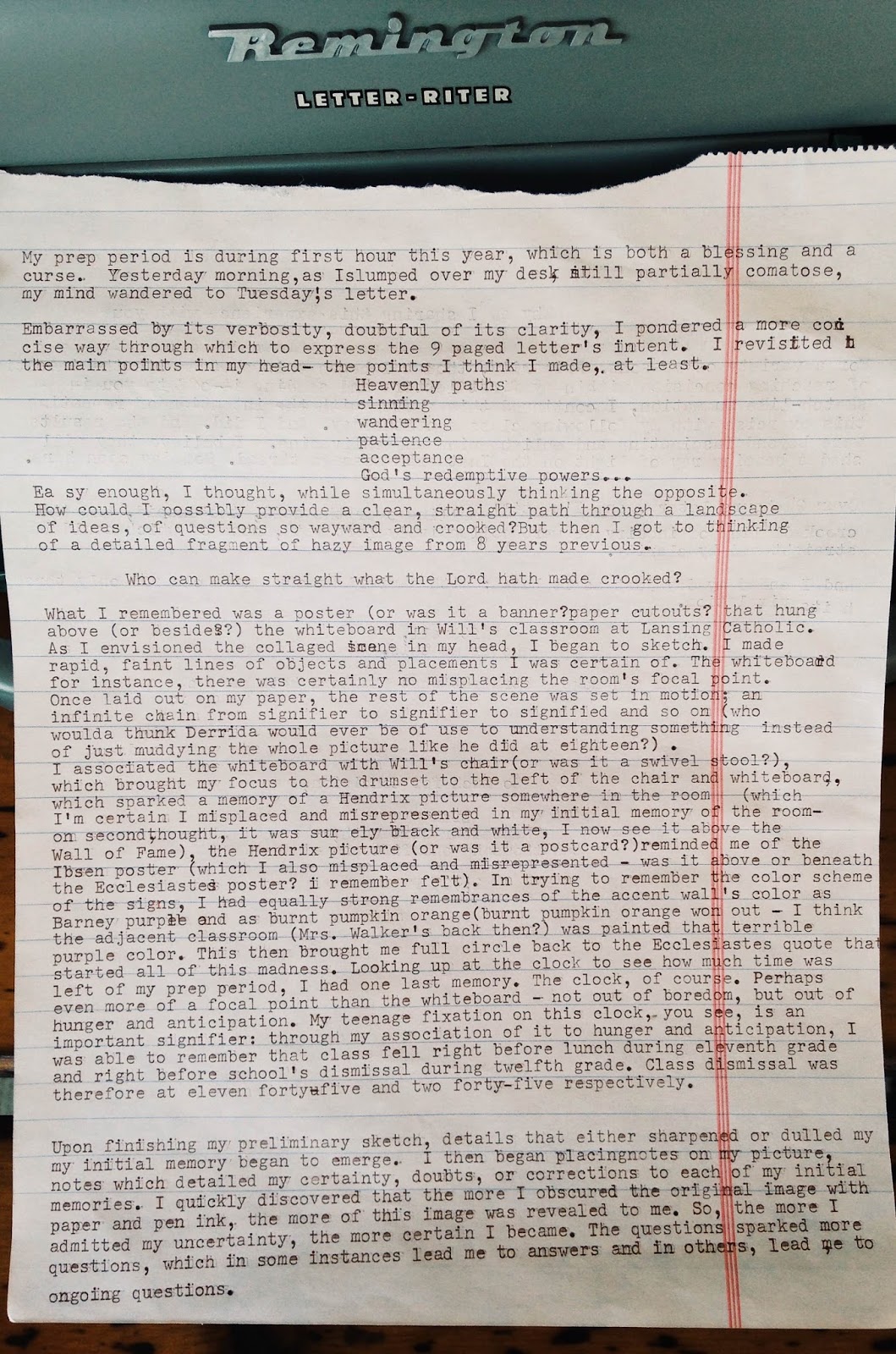
The following is a series of attached photos sent from Liza to the group. As usual, we publish typed excerpts of these illuminated texts along with the original photo. The best way is to read the text, of course, is to to experience it in its illuminated form.


My prep period is during first hour this year, which is both a blessing and a curse. Yesterday morning, as I slumped over my desk, still partially comatose, my mind wandered to Tuesday's letter.

Embarrassed by its verbosity, doubtful of its clarity, I pondered a more concise way through which to express the 9 paged letter's intent. I revisited the main points in my head—the points I think I made, at least.
Heavenly paths
sinning
wandering
patience
acceptance
God's redemptive powers...
Easy enough, I thought, while simultaneously thinking the opposite.
How could I possibly provide a clear, straight path through a landscape of ideas, of questions so wayward and crooked? But then I got to thinking of a detailed fragment of a hazy image from 8 years previous.

Who can make straight what the Lord hath made crooked?

What I remembered was a poster (or was it a banner? paper cutouts? that hung above (or beside?) the whiteboard in Will's classroom at Lansing Catholic. As I envisioned the collaged scene in my head, I began to sketch. I made rapid, faint lines of objects and placements I was certain of. The whiteboard for instance, there was certainly no misplacing of the room's focal point. Once laid out on my paper, the rest of the scene was set in motion; an infinite chain from signifier to signifier to signified and so on (who woulda thunk Derrida would ever be of use to understanding something instead of just muddying the whole picture like he did at eighteen?).

I associated the whiteboard with Will's chair (or was it a swivel stool?), which brought my focus to the drumset to the left of the chair and whiteboard, which sparked a memory of a Hendrix picture somewhere in the room (which I'm certain I misplaced and misrepresented in my initial memory of the room—on second thought, it was surely black and white, I now see it above the Wall of Fame), the Hendrix picture (or was it a postcard?) reminded me of the Ibsen poster (which I also misplaced and misrepresented—was it above or beneath the Ecclesiastes poster? I remember felt). In trying to remember the color scheme of the signs, I had equally strong remembrances of the accent wall's color as Barney purple and as burnt pumpkin orange (burnt pumpkin orange won out—I think the adjacent classroom (Mrs. Walker's back then?) was painted that terrible purple color. This then brought me full circle back to the Ecclesiastes quote that started all of this madness. Looking up at the clock to see how much time was left of my prep period, I had one last memory. The clock, of course. Perhaps even more of a focal point than the whiteboard—not out of boredom, but out of hunger and anticipation. My teenage fixation on this clock, you see, is an important signifier: through my association of it to hunger and anticipation, I was able to remember that class fell right before lunch during eleventh grade and right before school's dismissal during twelfth grade. Class dismissal was therefore at eleven forty-five and two forty-five respectively.

Upon finishing my preliminary sketch, details that either sharpened or dulled my initial memory began to emerge. I then began placing notes on my picture, notes with detailed my certainty, doubts, or corrections to each of my initial memories. I quickly discovered that the more I obscured the original image with paper and pen ink, the more of this image was revealed to me. So, the more I admitted my uncertainty, the more certain I became. The questions sparked more questions, which in some instances led me to answers and in others, led me to ongoing questions.

Wednesday, August 26, 2015

Simultaneously Villain and Savior

The following is an excerpt of an email sent from Will to Art on 6 August 2015.


I do see why we absolutely must engage the concepts of simulacra, the undead nature of language, and the secular worldview that derives from Camus and Sartre. I get why we need to engage Nietzsche, too, and any time I forget, I've got Planned Parenthood to remind me. Speaking of Derrida, I was thinking about your last major email, and the value in keeping Farthington "of indeterminant ethnicity" (I think those are DeLillo's words about Willie Mink; Jack Gladney also is frustrated by Orest Mercator for the same reason) and of having him set "indefinite longevity" as a goal.

Orwell talks about this idea that when Big Brother needs 2+2 to equal 4, it equals 4, and when he needs it to equal 5, it equals 5, but that's not exactly what Derrida is talking about.

Philosophically, we live in the age of O'Brien: the unborn child is a child when society needs her to be a child, a fetus when it needs her to be a fetus, tissue when it needs her to be tissue, a clump of cells when it needs her to be a clump of cells. But all we're really doing is doublethink: choosing temporary meanings.

Still, our increasing tendency to keep all options open approaches Derrida, where language is like a zombie--resistant to binary oppositions of words like "alive" and "dead." And for some reason, the more digital/binary our existence becomes, the more our communication becomes undead.

I think about this with that horrible Chevy commercial that borrows its plot from Sophie's choice: a mom must choose which child goes in the Chevy and which child goes in the car with inadequate airbag protection. The salesman who gives her the choice is also her savior, because he lets both kids go in the Chevy. So he is simultaneously villain and savior and neither and both...we can't sort the two out.

This undead thing works well for Farthington, who may or may not be alive, and who communicates digitally.

Tuesday, August 25, 2015

Polishing the Turd of Nihilism

The following is an excerpt of an email sent from Will to Art on 6 August 2015.

Camus stockholm.jpg
Camus in Stockholm

One thing I have been wondering about the project is why the French matter so much to it.

In my mind, they matter because the project needs to take on the philosophies of our age and expose their limits. Graham Greene nailed this approach in The Power and the Glory: a very weak, broken, and ineffective priest fizzles out and a noble, hard-working atheist lieutenant triumphs, and yet the triumph is empty and everything the priest stood for lives on or is resurrected in others.

I've come to see Arthur as this triumph of the Church, a type of lodestone of the Church. In and of himself we see both beauty and failure. His perfection doesn't lead anybody anywhere; his brokenness does, because the brokenness is completed by Christ. On the other hand, Farthington and Steffi are obsessed with perfect systems--the ultimate manipulations or the fruition of grand ideologies.

Somewhere in between are the French, who I think are about polishing the turd of nihilism. Camus and Sartre try to give us some sort of way to be Christian without Christ. Baudrillard and Derrida delight in exposing the limits of language. There's a poetry and a beauty to what they write, but with the former, I see misplaced faith in the lack of God, and in the latter, I realize I'm not chasing shadows of truth, just shadows of shadows of shadows. Of course, I'm not well-read enough in any of them, but out of all of them, Camus is the only one who holds my attention for long. I worry about things that spark my intellect without engaging my soul; I prefer the combination of the two.

And really, I worry that our project gets mired down in confronting these philosophies and that we don't direct enough energy toward its core, which in my eyes is evangelization. We have written far more criticism about the project than we have created the project itself, or rather, somehow the criticism has become the project itself!

We have a lot about exposing the limits of the world, but not enough drawing people toward the beauty of God. Perhaps I'm blaming French philosophy for this effect because it is the effect French philosophy has on me.