Showing posts with label kierkegaard. Show all posts

Wednesday, October 21, 2015

On the Side of Life

The following is an excerpt of an email sent from Art to Liza and the group on 18 August 2015.

Albert Camus

Thank you for sharing Peter Maurin's distinction between liberals and radicals. Of course, the same distinction could be made between conservatives and radicals, which may point to the fact that both are (were once?) rooted in similar bedrock principles. To make matters even more confusing, I used the terms "the left" and "the right" as in socialists and nationalists, which themselves have different meanings.

In defending your own position as not liberal but radical and then pointing out the follies of conservatism, I wonder if you were seeing me as a conservative (I wasn't seeing you as a liberal by the way). I don't think that fits me any more than it did Camus when Sartre and company ostracized him for not getting on the Communist bandwagon, turning a blind eye to its brutality. I am not in married to any ideas about the free market, trickle-down economics, strong military, small government, right to bear arms, greed, Don Gilber, etc.

As Camus said somewhere, "I am on the side of life."

I almost want to just leave it at that, because that's all there is to it for me. It is the simplest, most coherent of all positions, constitutive of all other values.

Now, I may need to understand that position more deeply, to integrate it more completely. But more contemplation, more sanctification, more poverty and/or personal fidelity to the Gospel will never change the fact that I am on the side of life. And not just on the level of the "fundamental option," but categorically (more on that later). Camus, who carried the philosophical project started by Kierkegaard and Nietzsche through to its most harrowing, coherent conclusions, arrived at this certainty. Dostoevsky seems to have finally arrived at a similar conclusion in his final short story (I read about this today on Brainpickings). And so have all of the saints.

Of course, it isn't fashionable to talk about the negative moral precepts associated with "I am on the side of life," namely, "Thou shalt not kill." After all, we're not supposed to be close-minded. But as Chesterton famously wrote,
Merely having an open mind is nothing. The object of opening the mind, as of opening the mouth, is to shut it again on something solid. Otherwise, it could end up like a city sewer, rejecting nothing.
The Church has always affirmed the existence of negative moral precepts. St. Pope John Paul II states this unequivocally in his encyclical Veritatis Splendor,
In the case of the positive moral precepts, prudence always has the task of verifying that they apply in a specific situation, for example, in view of other duties which may be more important or urgent. But the negative moral precepts, those prohibiting certain concrete actions or kinds of behavior as intrinsically evil, do not allow for any legitimate exception. They do not leave room, in any morally acceptable way, for the "creativity" of any contrary determination whatsoever. Once the moral species of an action prohibited by a universal rule is concretely recognized, the only morally good act is that of obeying the moral law and of refraining from the action which it forbids.
He contrasts this commonsense theological understanding with a perversion of the "so-called fundamental option," the idea that "freedom is not only the choice for one or another particular action; it is also, within that choice, a decision about oneself and a setting of one's own life for or against the Good, for or against the Truth, and ultimately for or against God." All of this, he says, has been an important and positive development in moral theology. But certain theorists have taken this line of thinking too far:
In some authors this division tends to become a separation, when they expressly limit moral "good" and "evil" to the transcendental dimension proper to the fundamental option, and describe as "right" or "wrong" the choices of particular "innerworldly" kinds of behavior: those, in other words, concerning man's relationship with himself, with others and with the material world. There thus appears to be established within human acting a clear disjunction between two levels of morality: on the one hand the order of good and evil, which is dependent on the will, and on the other hand specific kinds of behavior, which are judged to be morally right or wrong only on the basis of a technical calculation of the proportion between the "premoral" or "physical" goods and evils which actually result from the action. This is pushed to the point where a concrete kind of behavior, even one freely chosen, comes to be considered as a merely physical process, and not according to the criteria proper to a human act. The conclusion to which this eventually leads is that the properly moral assessment of the person is reserved to his fundamental option, prescinding in whole or in part from his choice of particular actions, of concrete kinds of behavior.
Of course, the Church teaches that there are certain intrinsically evil acts that cannot be done with your "heart in the right place." Certain acts, by their very nature, constitute a decision against God, a "no" to God. We know these as mortal sins. And though the Church acknowledges certain psychologically complex situations which may mitigate guilt, these are never normative.

Monday, January 12, 2015

The Eternal Return of Arthur White

The following is an excerpt of a 14 December 2014 email exchange between Art and Will. It should be noted that, since 1 November 2014, all Art's emails have originated from Farthington's account.

Sisyphus by von Stuck

More thoughts after a prolonged absence:

I want to be creative when it comes to the first incarnation of the Arthur White Concert for Iceland material. Of course, he did burst onto the scene already with the May 30th show.

I recently heard an interview with some entrepreneur saying that you want to look around for whatever resources are close at hand. What skills can the members of your various circles bring to the table. Ideally, you're not launching something that requires casting around for strangers who have the necessary expertise.

One thing that has popped into my mind recently is Arthur White, the ballet. My wife is looking for opportunities to choreograph some modern. I'm not sure that the mostly 4/4 time signature will be all that interesting. And then, we are friends with the owners of that ballet studio. It could start with just one song.

The point is that I want to really get creative, thinking inside the box, that is the resources that are closest at hand, and eschewing those that are beyond our scope: The words of Psalm 131:1-2:
I do not busy myself with great matters, with things too sublime for me. Rather, I have stilled my soul, hushed it like a weaned child. Like a weaned child on its mother's lap, so is my soul within me.
Could it be done in the style of a children's book? A program or press packet for a show that never occurs? A coffee table book?

This hits on what is at once a Christian and existential principle. On the Christian side, there is the affirmation, purification, and elevation of the raw materials of humanity. God does not seek another vehicle for his splendor, a new creation. He limits himself: "Him whom the heavens cannot contain the womb of one woman bore" (St. Augustine).

Similarly, there is Nietzsche's notion of the eternal return:
There is a lake which one day refused to flow away, and threw up a dam at the place where it had hitherto discharged: since then this lake has always risen higher and higher.
This is probably not the best quote, but the concept is summed up in countless other places, both by Nietzsche and others like Kierkegaard and Camus: the idea that the main source of our unhappiness is a constant flowing out toward some reality other than the present one. In The Myth of Sisyphus, Camus went as far as to call this tendency suicidal: the mental act of leaping from life into some other imagined world.

So the bottom line in the Return of Arthur White (dare I say the eternal return of Arthur White?) is an utter renunciation of all things beyond its scope and an total affirmation of all things within its scope. I realize, of course, that both Nietzsche and Camus saw God and Heaven as the main problematic horizons to which humanity flowed. I revise that idea without any difficulty in that God is immanent, that it is a false idea of God to place him on the horizon of our lives. Instead, our "search" for God must follow the very formula laid out by these atheistic philosophers, namely, we find him only in the moment and not in any idols, aspirations, or imagined accomplishments looming in the distance. Those horizons can be anything from waiting for the weekend, or the next performance, or Summer Break, or retirement, or Heaven. In a certain sense, Heaven is now--or never.

Pope Benedict (then Cardinal Ratzinger) grasped this idea when he wrote on the "duration" of Purgatory:
The transforming "moment" of this encounter cannot be quantified by the measurements of earthly time. It is, indeed, not eternal but a transition, and yet trying to qualify it as of "short" or "long" duration on the basis of temporal measurements derived from physics would be naive and unproductive. The "temporal measure" of this encounter lies in the unsoundable depths of existence, in a passing-over where we are burned ere we are transformed. To measure such Existenzzeit, such an "existential time," in terms of the time of this world would be to ignore the specificity of the human spirit in its simultaneous relationship with, and differentation from, the world. 
Encounter with the Lord is this transformation....
Joseph Ratzinger, Eschatology: Death and Eternal Life, p. 230-231

Wednesday, September 3, 2014

The Eternal Essence of Things

The following is an excerpt of an email sent from Art to Will on 14 August 2014.

Gustave Doré - Dante Alighieri - Inferno - Plate 4 (Dante meets Virgil).jpg
"Gustave Doré - Dante Alighieri - Inferno - Plate 4 (Dante meets Virgil)" by Gustave Doré (1832 – 1883) - Dante's Divine Comedy: Hell - Purgatory - Paradise. Illustrations by Gustave Doré, Translation by Henry W. Longfellow, Published by Arcturus Books, 2007. Licensed under Public Domain via Wikimedia Commons.

As Dante descends back down the slope guarded by the panther, lion, and wolf, he meets Virgil. As Arthur's prospects for stardom dwindle, he discovers Farthington.

Both guides believe that the next step is to bring their charges through the underworld. At that midpoint in life, it's safe to guess that both were trying to attain something that had evaded them up to that point. Dante's banishment from Florence had weened him of his primary focus on politics, and La Divina Commedia seems to reflect an attempt to reorient his life accordingly.

But, again, as he exits the dark wood of confusion and begins to ascend the mountain (representing some new ambition, perhaps literary achievement?), his ascent is halted by prowling animals. Interestingly, his subsequent path through Hell, Purgatory, and Heaven is set up by St. Lucia, Beatrice, and probably the Virgin Mary--all women. I'm not sure why that makes so much sense, but it does. Men and male characters--with the exception of maybe Hamlet--just go for the gold, which almost always turns out to be fool's gold. As usual, I'm fond of Nietzsche's characterization:
This is something that the Dionysiac man shares with Hamlet: both have truly seen to the essence of things, they have understood, and action repels them; for their action can change nothing in the eternal essence of things, they consider it ludicrous or shameful that they should be expected to restore order to the chaotic world. Understanding kills action, action depends on a veil of illusion--this is what Hamlet teaches us, not the stock interpretation of Hamlet as a John-a-dreams who, from too much reflection, from an excess of possibilities, so to speak, fails to act. Not reflection, not that!--True understanding, insight into the terrible truth, outweighs every motive for action, for Hamlet and Dionysiac man alike...now he understands the symbolism of Ophelia's fate...
I feel that I myself (not Arthur) am more like Dante in this regard. Arthur doesn't have any of those worldly ambitions. But a common midlife realization--sometimes taking the form of a midlife crisis--is that our male modus operandi is not getting us anywhere, not accomplishing anything. So we are subjected to this experience that seems so counterintuitive to us, that terrifies us: to be dragged in the opposite direction of our dreams and ambitions, toward the "eternal essence of things." And yet, paradoxically, that is how and why the great work finally gets written. Who knows what would have happened if Dante had gotten past the three beasts, grisly counterparts of his benefactresses in Heaven. Safe to say it wouldn't have been as good as the Divina Commedia. And so, we need to turn our attention away from the hideous aspect of the three beasts and toward the benign influence that frustrates, hampers, and ultimately coaxes us away from Hell-bent ambition and self-sufficiency. Then and only then, having traveled that seemingly opposite path through to its end, do we have the possibility (not the guarantee!) of receiving the original object of our striving, like Kierkegaard's Knight of Faith.

Looking at the present status of the project, it does seem like we have an opening, a way forward. But to what extent will it consist in trying to weave our way past panther, lion, wolf? I want out of the woods as much as the next guy, I want to finally find some way to ascend! This other path--the one I have described--seems darker, obscure. And yet, in a way, that's where the dream was conceived: in darkness. "What I say to you in the darkness, speak in the light; what you hear whispered, proclaim on the housetops" (Mt. 10:27). And so we proceed into the light of day, but inwardly embrace that experience of darkness, which leads us on an entirely different journey. Because we want our proclamation to be somehow true to the original whisper, the original darkness. But how can the dark beauty of those words be preserved in the light of day? Should we shout them up from the bottom of a well?

On the surface of things maybe nothing looks different. It's the anguish of the Kierkegaardian guy who has an existential crisis about whether or not he should go to Deer Park, and then ends up going to Deer Park like all the other plebs in Copenhagen. But because of his experience of inwardness, his action is subjectively different than the others who go to Deer Park as a matter of course, because it's the thing to do. What the Dionysiac man, the Knight of Faith, the thwarted Dante, the middle-aged man, and Hamlet have in common is that they are deprived of knowing the propriety or essential rightness of this or that course. But balanced on that fulcrum, they may finally spy a kind of freedom, something that makes them more than just a "pipe for Fortune's finger."

Whether or not actions in this dark, perplexed, anguished, angst-ridden, hidden, swaddled, crucified state have greater efficacy matters not. In some cases, such an experience of inwardness seems to produce a better result: Dante wrote his Commedia, Oedipus at Colonus bestows divine blessings. In other cases, it produces the same result: Abraham got his nation, Hamlet avenges his father and purifies the kingdom. In still other cases, it does not produce the desired result: Kierkegaard never got back his would-be bride.

Nietzsche thinks it's a good thing:
[Oedipus at Colonus], afflicted by an excess of misery, abandoned to every misfortune that comes his way as a passively suffering man, is confronted by a superterrestrial cheerfulness that descends from the gods, which suggests to us that the hero, through his passivity, has found his supreme activity, the effects of which will resonate far beyond his own life, while his conscious strivings in his former life led him only to passivity.
Most of the above discussion has been in tragic terms, but per our earlier discussions I would say this experience of darkness is ultimately and fundamentally comic, no different from the Sweet World, the Forest of Arden, the Garden of Eden. How silly to think of ambition and self-sufficiency sub specie aeternitatis, in the arms of a loving Creator and Redeemer! Do the three sainted women just appear like prowling beasts, mortal enemies of our ambition?

How tragic that would be--and yet at the same time, how comic!

Sunday, August 24, 2014

Come-From-Behind Comic Victories

The following is an excerpt of an email sent from Art to Will on 4 August 2014.

More thoughts about why artists and prostitutes don't fit in to the usual progression of aesthetic, ethical, religious.

Whenever a group takes away the religious sense and tries to reduce faith to an ethical proposition, it spawns artists, druggies (of the psychedelic, not hedonistic, variety), and prostitutes as a "4th sphere"--almost a kind of limbo.

That's exactly what the Pharisees did. That's exactly what Pentheus did. And thus, you have prostitutes and tax collectors trying to get beyond that wall by breaking its rules (not the ideal, normative way through, by the way!). A similar thing seems to have happened in our own day, but actually both the the religious and the ethical senses are being attacked, leaving nothing but the aesthetic. You're right that there are no "noble Romans" in our day. Fr. Bernard could be turned into one, but I don't think it would be edifying for anyone.

You should never harsh the Bacchants' mellow frenzy
This phenomenon is bound to funnel a lot of would-be mystics into various distorted paths. I think I enumerated some of them back in our meeting at the diner: psychedelic drug use, sexuality, cult membership, bacchic rites of music (think Jimi), insanity, etc. All of these would be characterized by an inarticulate longing for the ecstatic union of the religious sphere, a longing that Christ seems to have readily picked up on.

That is why you and I rightly (I think) have so much more admiration for a Marvin Gaye or a Gil Scott-Heron than we do for the guy who comes to church wearing his team's gear, goes down for donuts, and talks about yesterday's game. I know that God is a lot more merciful than us, by the way. But I have little patience for people who presume to judge why these artists suffered such an ignominious demise. "They should have never left the Shire!" is what these Chubs, Grubs, Boffins, and Brandybucks would say! No, they risked traveling a very high and narrow path, without the guidance and expertise that existed in past centuries, and therefore had a long way to fall.

Is it wisdom to stay close to Hell so your fall isn't as profound?

I hope that the one who "began a good work" in some of these Pancake Breakfast types "will continue to complete it until the day of Christ Jesus" (Phil. 1:6). And that is one of the more beautiful things about our religion: it finds everyone where they are and comes up with some unlikely, miraculous, come-from-behind comic victories.

Thursday, August 21, 2014

Womb-like Place

The following is an excerpt of an email sent from Art to Will on 4 August 2014.

He isn't Tommy
"Womb-like place" makes sense.

I would bet that Arthur would pick up on his mother's issues as a teenager but like you said be fed by the charity. Kids trust their moms, and young Arthur wouldn't cause her much grief--she'd probably be affirmed in her works by the fact that her young son loves the Lord so much.

Incidentally, how could Lena make Will vow to make Arthur a star on her deathbed?

Because she can't stand to see Arthur suffer and without realizing it puts her family's security ahead of her relationship with God. Her relationship is in so many ways about protecting the family. That's the issue that has to be worked off in Purgatory. And the oddest thing about Arthur in the family's eyes is that family doesn't seem like that big of a deal to him. That's partially because his eyes are on God, not his home, and partially because he loves everybody--even people who abuse him. Somehow this self-made immigrant family had a kid with seemingly no survival instincts at all! He's intensely generous but not philanthropic because worldly wealth is worthless to him, and he loves everyone but can barely communicate with anyone without music because his vision of reality is so different than everyone else's--there's very little common ground.

Still, he isn't Tommy or a high functioning autistic. He's a mystic.

I never made the connection between Augustine and Kierkegaard, but it makes a ton of sense. I'm not sure if the world we're creating has any of those noble Romans in it! But I do see how lots of people I would characterize as living in the moral are probably closet aesthetes. I've probably just let too many of my Catholic educational experiences harden my appreciation for the moral.

I think the most important thing we can do in Catholic education is lead kids to the Eucharist, but instead we work like crazy to mandate good behavior. The result seems to be a lot of kids who don't get caught doing bad things frequently and don't have much interest in a personal relationship with Christ. Parents want us to help raise good kids, but are terrified that we'll raise Jesus freaks. People fear the scandalous side of Christ. But I think there might be some adventure in following the scandalous Christ that would appeal to the aesthete.

Wednesday, August 20, 2014

"Catapulted" into the Religious Sphere

The following is an excerpt of an email sent from Art to Will on 4 August 2014.

As for messages getting buried: That was one of the issues that I thought would get handled by taking the emphasis off mimesis and taking a diegetical approach--or at least more diegetical. We can talk about the story just like we do in our emails and, by extension, the blog. I was actually of the opinion we should go totally diegesis in our podcast. I think it lends itself to our strengths of telling not showing and it is a classical, Platonic solution to the problem of having the opposite of our desired, edifying effect on our audience.

Where is Jimi Hendrix located?
In deference to St. Augustine, I'm going to disagree that the ethical sphere is absurd and banal (I'm of the opinion that Kierkegaard got his ideas for the spheres of existence from Augustine's City of God). Augustine just betrays too much admiration for the highly ethical Romans he uses as examples of how close some pagans came to the kingdom. I would say that most churchgoers are actually in the aesthetic realm trying to work around or bargain with the ethical when absolutely necessary. The ethical realm is characterized by a willingness to die rather than to sin. I think ethical is rightly considered the realm from which one is "catapulted" into the religious sphere.

So where are Jimi and Arthur and prostitutes and Carlton Farthington located? It might be difficult to locate. But modern artists and would-be mystics might consider the ethical sphere impossible to stomach without the more complete revelation of the religious. They are different than the aesthetic types who just want to burn their eyes out on Netflix every weekend and buy a cottage someday.

For this reason, I also think Arthur would have picked up on the unnaturalness in Lena's charitable activities. The Sweet World is way bigger than that. It wouldn't feel as natural as breathing to him, but it might have been a womb-like place where he found some nourishment.

Monday, August 18, 2014

Buried Under the Plot Twists

The following is an excerpt of an email sent from Will to Art on 4 August 2014.

Thomas Merton at his hermitage
So Arthur is a child in the embrace of his mother' Old World Catholicism which feeds him a rich supernatural view of the world, plus his mom obsessively serves the poor (although in a misguided way), which makes Arthur feel that service to the poor is as natural as breathing, which it is in the Sweet World.

Then Arthur is an adolescent in a post-Vatican II world that replaces the organs with acoustic guitars and pianos, flips the altar around, replaces oil paintings and stained glass with felt banners, the stone and marble with drywall and pine.

Then in his autumn years, the Church becomes an extension of people's right-wing political affiliations! Meanwhile, angels are singing the triumph of Christ, demons are fleeing in terror and trying to knock as many of us over as they can as they are rounded up, Jesus is inviting us to walk on water, etc!

I've been looking at the project in terms of what it should say to non-Catholics, but you have nailed what it should say to Catholics! So many of us are Will Witkowskis, viewing our faith like it's something we ought to do but not absolutely necessary to live good worldly lives, like saving 10% toward retirement, exercising, or flossing. We don't get that God is our life itself, not the bonus prize at the end of an esteemed career and well-funded retirement.

By the way, regarding this:
Maybe we visit Arthur in a small hermitage. Maybe he has even become a priest through some special dispensation (he wouldn't be able to get through any of the heavy theological study--I'm sure there is some example of this in history).
How about St. John Vianney, whose feast day is today?! We picked a good day to pray the daily readings!

So how do we keep these messages in the right places in the story so that they aren't buried under the the plot twists or spelled out by some lame chorus? I don't know that the messages peek out clearly in every podcast, but prolonged exposure should clarify them.

I'm inclined to say that Joe Lazarus, Sr. and Jr. are the mechanisms. That Joe Sr. is destroyed by his pursuit of God (as Arthur experiences Him) and that Joe Jr. is saved by it.

Also, Joe Jr.'s parents are inversions of Arthur's. Joe Sr. was an absentee dad where Stan was about moving heaven and earth for the misunderstood good of his family. Joe's mom is what Fr. Joe calls "The Frozen Chosen," where Arthur's mom is an activist.

I also think back to Kierkegaard. In some ways, the religious sphere is closer to the aesthetic sphere than the moral sphere. Maybe the story can reach people in the aesthetic who long for the truth and beauty only the religious sphere can offer. And maybe Will demonstrates the absurdity and banality of the moral sphere.

Tuesday, July 22, 2014

That's Not a Flaw! The Other One is a Flaw!

The following is an excerpt of an email sent from Art to Will on 1 July 2014.

We are somewhat far apart in that I see the Greeks as having gotten extremely close to many things (in a "You are not far from the Kingdom of God" kind of way). The main philosophers were all monotheists, and later Platonists--especially Plotinus, one of Augustine's favorites--actually got darn close to hitting on the Trinity.

The Birth of Jesus by Barna da Siena
And on the literary side, you probably know by now that I think Tragedy approaches the heroism of the cross a lot more than do the other genres. Oedipus' pinned ankles are so reminiscent of the swaddled/crucified existence, discovering the limits of human freedom and yet achieving a kind of mastery, a kind of victory in that moment of greatest ignomy and defeat.

Perhaps they were asking the question, how can one be a hero when the age of heroes is over?

And Kierkegaard's Abraham (or just Abraham, really) gets very close to this quandary as well. The whole episode leaves us with far more questions than answers. Definitely no "pat" answers, and the Deus ex Machina, if you will, is not definitive or satisfying. The problem I have with the solution being, as you say, "alignment with God's will" is that it doesn't answer the fundamental questions posed by this episode in Abraham's walk with God--or, for that matter, any of the questions implicitly posed by the tragic figures of pagan times.

So what is the answer? Jesus Christ. But he is--and I say this with the utmost reverence--an answer that is irrational and irreducible. In other words, he cannot be reduced even to a complicated code of ethics or philosophy. Yes, he said things like "It is not everyone that says to me, 'My Lord, my Lord'', who enters the Kingdom of Heaven, but whoever does the will of my Father who is in Heaven" (Mt 7:21), but that's not all he did and said. He was wrapped in swaddling clothes and placed in a manger! He was baptised by a human being! He was crucified, died, and was buried! He comprehends everything that has happened before and since. He doesn't stand dumbfounded before the fate that Oedipus or Abraham suffered. And as inarticulate as those questions might have been (and I have a hard time calling Sophocles inarticulate), he comprehends all contradiction, paradox, ambiguity, irrationality and provides the answer in who he is. Note that I didn't say he just tells all those things to shut the f--- up (although he does that with the wind and waters sometimes). He comprehends them within his person.

I disagree with the phrasing that "from Marlowe onward, we've got tragic heroes who aren't marked by Olympus to suffer, but who bring about their own suffering, although there are always extenuating circumstances."

I think it's close to, but not as accurate as the Aristotelian characterization: "a man who is not eminently good and just--yet whose misfortune is brought about not by vice or depravity, but by some error or frailty" (Chapter 13). That's a very nuanced emphasis--the difference between tragic flaw and hamartia--but, as a professor I once heard explained, "His error is inextricably tied up with his human greatness." His greatness, that which places him above his fellows, is his willingness and ability to face his fate directly.

Neither did Arthur Miller believe in the traditional conception of a tragic flaw:
In the sense of having been initiated by the hero himself, the tale always reveals what has been called his "tragic flaw," a failing that is not peculiar to grand or elevated characters. Nor is it necessarily a weakness. The flaw, or crack in the characters, is really nothing--and need be nothing, but his inherent unwillingness to remain passive in the face of what he conceives to be a challenge to his dignity, his image of his rightful status. Only the passive, only those who accept their lot without active retaliation, are "flawless." Most of us are in that category.
For Miller, the flaw sounds like a good thing! Kind of like how people answer that question that they ask in job interviews: What is one shortcoming that you have?

Answer: Oh, I guess I have this unwillingness to remain passive in the face of what I conceive to be a challenge to my dignity. I guess I don't just accept my lot without active retaliation.

Come on, that's not a flaw! The other one is a flaw!

Thursday, June 26, 2014

The History of Arthur White: Brand New Life

The following is an excerpt of an email sent from Will to Art on 2 January 2013.

Will moved Arthur back into the family home and spent a few months nursing Arthur back to health.

He saw Arthur's downfall as his own fault and decided that he would do a better job this time around fulfilling his promise to their mother. He went to their local parish and got the name of Fr. Bernard, a priest with a counseling degree who was an accomplished musician and started bringing him by the house to counsel Arthur. Fr. B also spent a lot of time talking with Will and helped him realize the mistakes he had made with the Sweet World. Will decided that if he helped Arthur put a band together with people he liked who were living good, Catholic lives, and if he held back the pressures of touring and recording, Arthur would be able to become the person he was meant to be. Arthur loved the idea and named the group Brand New Life, which Will modified to Arthur White's Brand New Life.

The early days of Brand New Life were some of the best Will and Arthur had together. Will rented a home in the country and moved the whole band in together. Everyone, even Will, went to daily mass. Everyone played music, cooked meals, did chores. After a while, Agniesczka even visited with the children. Will was able to keep an eye on the company, which helped resolve some tensions with Anthony, who was still angry that Will completely dropped out of the picture during The Sweet World days. Arthur especially bonded with Joe Lazarus, a guitar player and recovering drug addict. The two of them became accountability partners and, for the first time, Arthur had a male friend he could trust other than his brother. He and Arthur both took to their therapy of praying while making felt banners, and together they made the album cover for the first Brand New Life album. The band played softball with the Rockets and other Detroit bands, which Will loved because it gave him a chance to goof around with his old buddy Johnny Bee Badanjek.

The success of Brand New Life was a complicated blessing. Arthur's therapy and prayer life helped him so much that he not only regained his ability to return to the Sweet World almost at will, but he realized that the woman was the Virgin Mary and her child was the baby Jesus! Arthur's channel to the divine reopened, and this time around, Arthur could enter it as a healthy adult. The result was that by the time Arthur was supposed to make the second Brand New Life album, he was ready to make an album of prophecy about Christ's redemption of a fallen America--not at all the sort of record Will wanted the group to make. Will was like most Catholic Americans: he believed in a happy medium of heaven and earth in which heaven is the optional cherry on top of the sundae of a productive life. He was like parents who get their kids Catholic educations to get them into college--not heaven. Will would see Kierkegaard's ethical sphere as the highest acceptable sphere of existence, but the religious sphere is just nuts.

Somehow, he never once had an experience of God that disrupted his concrete view of reality even for a moment.

Friday, February 28, 2014

Why Does Arthur's Marriage Break Up?

The following is an excerpt of a 29 December 2012 email sent from Art to Will wherein Art answers certain questions about Arthur's involvement in Carlton Farthington's cult.

Because it's built on hiding, on inauthenticity.  

In the beginning, his wife believes that he is fully capable of operating within the (high-ish) aesthetic sphere, as many even orthodox Catholics seem to do.  

Fact is, he's totally incompatible with that sphere.  

So, as Jung would say, whenever natural expression is suppressed, it finds its way out eventually--only this time in a neurotic form.  So that could take the form of infidelity, of wanting his wife to be his All-in-All, of trying to live a monastic-type spirituality in the midst of his marriage, or all of the above.  

He would be a pretty intense person to have to live with and that's not exactly what she signed up for.

Wednesday, February 19, 2014

Working on My Frontman Swag!


The following is an excerpt of a 19 December 2012 email sent from Art to Will.

Joe Lazarus intersects with all of this in that he simply sees the makings of a great documentary.  

Maybe he represents the ethical sphere.  He is definitely beyond Will in that he has some social consciousness and wants to draw out some comprehensible message or moral.  Maybe he sees it as a simple triumph-of-the-human-spirit-type story.  

Now that Arthur has been turned into a 2001-type catalyst for existential/religious evolution, however, Joe  is going to get a lot more than he bargained for.  Arthur isn't going to give him anything that can be clearly articulated or comprehended within the ethical sphere.

He'll have to evolve or turn back.

I also see Will's character through the Nietzschean lens, as representing the Apollonian impulse to control, rationalize, and package the formless Dionysian horror that Arthur represents.  If we are to baptize Nietzsche, that formless horror is akin to your Catholic parents' utter horror of mysticism, of the religious sphere, of sainthood, of ecstatic visions, of dark nights, etc.  

This is a good impulse on Will's part, because a lot of people with this disposition tend to stick with things that are easily packaged, or that are already packaged in some sense.  Will recognizes the necessity of the Dionysian and he's going to get as close to the event horizon of the black hole without getting sucked in.  Like Willy Loman, he's going to reach into the darkness and pull out a diamond!

Incidentally, I want to, as Covey puts it, "value the differences" here.

Apollonian and Dionysian are like oil and water.  But without the other they produce nothing.  Pitted against each other they produce the great works of Aeschylus, Sophocles, Ibsen, and Wagner.  I don't want to say that you and I represent one more than the other, but I do think some of the creative tension we are experiencing now is a good sign.

Hegel would think so too.

Anyway, I hope that doesn't sound too arrogant and self-centered again.  I am, after all, working on my frontman swag!

Tuesday, February 18, 2014

What Comes Out is Pure Prophesy

The following is an excerpt of a 19 December 2012 email sent from Art to Will.

I agree with you that the other characters need to be developed, to be protagonists in their own right.

I may have less insight into them because their personas derive (at least in part) from you and Joe.  Also, having written more poetry and songs than fiction, I'm not as adept at juggling multiple characters in a large, expansive plot as you are.

The only thing that I'm trying to represent is my sense of my own character and the songs, many of which I haven't had a chance to play for you yet.  I don't think it's that big of a difference of opinion philosophically.

Actually, it may be less philosophical as it is the organization of events.  

Without getting into super long paragraphs again, I just think that the marriage/children have to come first (toward the end of the Sweet World era) for the progression of songs to make sense.

Then losing the band-->short stint with Apotheosis-->losing wife, kids-->joining a cult, getting out of the cult-->getting electroconvulsed-->getting propped back up by Will to front Brand New Life.  

Brand New Life is ironic because for Will it's just an attempt to do definitively what he has been trying to do all along: whitewash all the mystic mumbo-jumbo and bring Arthur back down to the Kierkegaardian aesthetic sphere where he can be made profitable.  

The irony is that this "final solution" actually does the exact opposite, making Brand New Life a true resurrection of the original Arthur, catapulting him definitively into the religious sphere, never to descend again.  

Now, in spite of (because of?) his destroyed mental state, he speaks prophetic words that cut like a double-edged sword.  He's kind of like Dave Bowman has become by the movie 2010.  Unlike Dave, however, Arthur may be thoroughly broken on a human level--mental anguish can still be occurring.

But when he sings, what comes out is pure prophesy.

Monday, February 17, 2014

The Point of View for My Work as an Author

The following is an excerpt of an email sent from Art to Will and Joe on 13 August 2013.

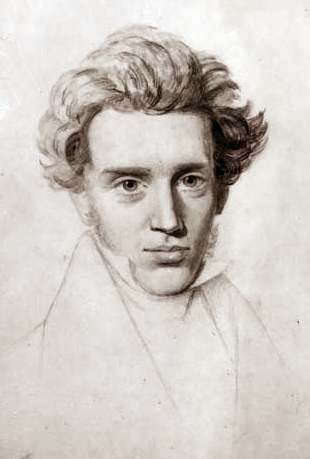
Søren Aabye Kierkegaard
Hope you're both transitioning smoothly into the next phases of your lives.  

I'm up on my annual trip to the UP and reading lots of Kierkegaard.  I just finished reading The Point of View for My Work as an Author and it's blowing my mind how similar our approach was to his.

Here's my favorite quote:
The religious writer must, therefore, first get into touch with men [who Kierkegaard believes live in the aesthetic, or at best, aesthetic/ethical stage].  That is, he must begin with aesthetic achievement...The more brilliant the achievement, the better for him.  Moreover he must be sure of himself, or (and this is the one and only security) he must relate himself to God in fear and trembling, lest the event most opposite to his intentions should come to pass, and instead of setting the others in motion, the others acquire power over him, so that he ends by being bogged in the aesthetic.  Therefore he must have everything in readiness, though without impatience, with a view to bringing forward the religious promptly, as soon as he perceives that he has his readers with him, so that with the momentum gained by devotion to the aesthetic they rush headlong into contact with the religious. 
It is important that religion should not be introduced either too soon or too late.  If too long a time elapses, the illusion gains ground that the aesthetic writer has become older and hence religious [a common interpretation of Kierkegaard's output over time].  If it comes too soon, the effect is not violent enough. Assuming that there is a prodigious illusion in the case of these many men who call themselves Christians and are regarded as Christians, the way of encountering it which is here suggested involves no condemnation or denunciation.  It is a truly Christian invention, which cannot be employed without fear and trembling, or without real self-denial.  The one who is disposed to help bears all the responsibility and makes all the effort.  But for that reason such a line of action possesses intrinsic value.  Generally speaking, a method has value only in relation to the result attained.  Some one condemns and denounces, vociferates and makes a great noise--all this has no intrinsic value, though one counts upon accomplishing much by it.  It is otherwise with the line of action here contemplated.