Showing posts with label the sweet world. Show all posts

Sunday, June 7, 2015

Introducing Liza!

The following is an excerpt of an email sent from Liza to the group on 17 April 2015.


Hello Allison, Arthur, Carlton, Will, Will, and any of the others hiding amongst us,

What a full room we have here!

Here I am, at long last. Here I have been all along.

As you will soon see, my presence in this project will be much like that of a fly on the wall. Even in the long intervals that are likely to pass by without any buzzing on my end, know that I am watching, reading, interpreting, and reflecting on your messages. Once I've digested them as best I can, I will swoop in, impose my character(s)' rationality on what Art has called the “primordial wildness of [your collective] scribbles," and fly off once more. Never mistake my silence for disinterest. On the contrary, understand that it is only through the emptiness of the silence that I discover the joy of the noise. Though Allison is light-years ahead of me on her journey through The Sweet World, I’d like to think the degrees of our excitement are equally matched.

While on the subject of Allison – hello! Though we’ve never been in direct communication with one another, I already feel, in some sense, like I know you. Instead of filing my taxes last night, I spent my evening bouncing back and forth between Civilization and its Discontents, Leaves of Grass, and your thesis. I’m yet to make a significant dent in it, but I can already tell that every atom belonging to me as “legend” also belongs to you.

To all of you, really. What great company I’ve stumbled my way into.

I’m tempted to call you members of what Vonnegut’s Books of Bokonon would describe as my karass, but I won’t. Whereas Bokonists derive their life's meaning from foma - shameless untruths - I attribute the entanglement of our lives to our mutual interest in deriving life's meaning from transcendent Truth. A force exists in our communication that is far beyond us; there is a deeper meaning in it than any of us can perhaps currently fathom.

I dig this idea of understanding the meaning through the medium. As we discuss our potential roles in this project, I've been thinking a great deal about how the indefinite process of contextualizing the essence of these roles in turn enlightens our existence both inside and outside the Sweet World. Through this lens, it’s interesting to consider the dialectic of the Apollonian and the Dionysian - this sense that we clarify our confusion in the journey through the interplay of these oppositional forces.

In response to a message I sent to Will last night regarding my own bewildering journey to restore order to the chaos that saturates our public education system, he sent me a passage from Chesterton’s The Man Who Was Thursday that further highlights this unifying duality. What I’ve ultimately deduced from all of it is that the meaning of each of our respective roles in this project and beyond has been distorted by what Chesterton calls “an engine of torture."

The purpose of the Sweet World - from my own understanding at least - is to provide us a space in which to translate this meaning not despite this distortion but through this distortion. If the lodestone that Art mentioned confuses our identities, then it is really the most clarifying force there is in our route to understanding our identities.

When I wrote last night's message to Will, I had not yet read through the entirety of this e-mail thread. Now that I have, the line between my purpose in life and my purpose in this project has been reduced to a dash. It is through my daily struggles to contextualize my transcendent purpose amongst grave misfortune that I’ve discovered an inherently meaningful connection to the contextualization of my role in this project.

After writing said message, it dawned on me that I didn’t so much write it as I did sit down at my typewriter and bleed it into being. Though most writers seem to disagree on the attribution of this paraphrased quote, they (maybe) unanimously agree on its merits.To write in such a way, we must abandon our mortal vulnerability  by ripping open our wounds. To look upon these wounds with rapture instead of lamentation is to have paved a clearer channel between the earthly and the divine. It is to, as Coleridge says, "build that dome in air."

I often think Detroit could be one of our earthly channels into the divine. Whenever I hear someone refer to it as a "blank canvas," I want to shake my fist at the sky in horror that they don't see it for what it really is: the Sistine Chapel of the Midwest.

Though Nietzsche uses this blood-writing metaphor to promote earthly elevation of the Übermensch over the Untermensch, I’ve decontextualized parts of it below in order to support the above idea:

“Of all that is written, I love only what a person hath written with his blood. Write with blood and thou wilt find that blood is spirit."

"He that writeth in blood and proverbs doth not want to be read, but learnt by heart.”

My decontextualization of this is that our willingness to suffer into Truth is not for worldly pleasure - that of the head - but rather to satiate our yearning for the divinely transcendent - that of the heart.

The text concludes: “Now am I light, now do I fly; now do I see myself under myself. Now there danceth a God in me.”

So, in a sense, this is how we define ourselves in opposition with ourselves: we can either give into the temptations of man, exalting ourselves to übermensch, or we can remain steadfast in our rejection of these temptations, isolating ourselves as the untermensch.

As the fly on the wall, it seems apparent that Art and Will are not writing The Sweet World into existence, but rather bleeding it into existence. In my decontextualization of Nietzsche, this is indicative that God is dancing through you.

With this dance as my aim, I prioritize the process over the purpose. Through a certain lens, this process is our purpose. The difficulty then lies not in understanding, but in discovering the courage through our confusion to present our woundedness to the world as Jesus did. Though this will inevitably yield more wounds in the short term, the moment we fixate our gaze on the gore despite our worldly instinct to avert our eyes is the moment we will see Beauty and know Truth. As Rumi says, “The wound is the place where the light enters [us].”

In keeping our veins open, we will come to see the light that will guide us into the caves. It is this light that will not only illuminate The Benefactor's horror-raps etched on the crumbling walls, but that will keep our eyes steady on them despite all impulse to look away. Though this is all lofty idealism at best, I have trouble envisioning a better alternative than this in combusting “the engine of torture."

On that note, it appears as though I’ve rambled my way to the edge once more. Perhaps the edge of the cliffs is where the Sweet World exists. After all, if you're an outlier of the world, you're an inhabitant of the Sweet World.

As my favorite secular-humanist once said,

“I want to stand as close to the edge as I can without going over.  Out on the edge you see all kinds of things you can’t see from the center.”

Until my next swoop,

Liza

Wednesday, May 13, 2015

Crazy Hippies

The following is an excerpt of an email sent from Will to Art on 29 March 2015.

20000 squid Nautilus viewbay.jpg
Captain Nemo witnesses the attack of the squids from the viewbay

I'm still stuck, but I'll continue to ponder.

Arthur Miller's common man isn't a mystic, and as figures of science go, Farthington is kind of cartoonish...kind of in the tradition of Verne, Stevenson, and Wells, but sillier.

I get that there is a fallen analog to the high road, but I don't get why he wouldn't take a more attractive low road. I guess I don't see what Knology offers that can even seem better than the mystical visions. If I've seen and had conversations with Mary, what could Farthington possibly say that would stand up to that? I can get being hollowed out, but why in that situation would he not just be hollow.

Why not either succumb to entropy or fight to get Mary back?

I can see friendship being a motivator, and I can see being understood as a motivator. What am I missing in Farthington? Is part of my problem that cults have never really had much appeal to me, other than as tabloid entertainment, a moment to say, "Those crazy hippies..."?

Scripturally, I've been thinking a lot about Jesus' words to Nicodemus in John:
For God did not send the Son into the world to judge the world, but that the world might be saved through Him. He who believes in Him is not judged; he who does not believe has been judged already, because he has not believed in the name of the only begotten Son of God. This is the judgment, that the Light has come into the world, and men loved the darkness rather than the Light, for their deeds were evil.
The last line especially gets me. There is a crystal clarity and simplicity to it. Don't worry about the judgment, because it is totally obvious what the judgment is--God gave you The Light and you preferred the darkness. Now let's get down to brass tacks...salvation. The judgment is easy and obvious. The salvation is baffling. I think about the balance of those two ideas in our story telling. We are pretty good at baffling and convoluted, but I want that aspect of clarity, too. In sharpening cliches, I guess I want to follow Jesus' lead in showing the simplicity of the complex and the complexity of the simple.

That quest informs every part of the story to me, but I'm still hung up on Arthur and Farthington. In your vision of Arthur, are the mystical visions just part of childhood, and does he not know that Mary is Mary or that The Sweet World is new creation? I've always thought of Arthur having visions throughout his life. Does he dull them with the sensual life and Farthington helps give them back to him?

Is Arthur just dumb? I don't like that idea much. Somehow in my mind, he keeps turning into Peter Sellers in Being There.

I know that you have to repeat yourself a lot to answer this question and that I'm slow in understanding it. I appreciate your help!

Also, I feel bad that I still haven't seen Household Saints. I just haven't figured out a way to get a hold of it.

Sunday, May 10, 2015

Why Does Arthur Follow Farthington?

The following is an excerpt of an email sent from Will to Art on 29 March 2015.

Laputa - Grandville.jpg
Laputa's observatory contained the lodestone, which enabled it to float.
So, in my quest to have our story communicate a Catholic message, I'm trying to reassess, given the ways characters have blurred since their inception, some of the big character and plot questions I have.

For now, I've got this one: why does Arthur follow Farthington? More precisely, why would a guy who sees visions of Mary and the Garden of Eden and/or the new creation (The Sweet World) have anything to gain from following Farthington?

At this point in the story's development, it is that Farthington has found concrete evidence of things Arthur has experienced in mystical visions. Because he is the only guy walking around with proof of a reality nobody else believes Arthur experiences, Arthur assumes Knology must mean something, too. Unfortunately, Farthington has just stumbled onto the lodestone, the tunnels, the secrets of Iceland, etc.

What we get then, is a variation on the theme of something simultaneously being true (the lodestone) and untrue (Knology). Arthur has visions of Farthington playing a heroic role in the perils of turbulent reversals, but hasn't seen a complete enough picture of Farthington to distrust him.

I feel like I've made Arthur's attraction to Farthington too simple for your tastes, but I'm wondering if I'm on to something. I need a reason why someone who sees the splendor of heaven would cast that splendor aside for Farthington. It seems more likely that he would have to attach to Farthington to serve his quest to reach The Sweet World than to reject that quest in favor of something as empty as Knology.

Wednesday, April 15, 2015

The Hyacinth Girl (Part 2 of 3)

The following is an excerpt of a Facebook message sent from Liza to Will on 25 February 2015.

Smoke from street

How I long to step my feet
Upon these waters that have lured
Me down a certain half-deserted street,
but my vision is obscured...

How then shall I begin?
In a minute is there time
For my answer deep within
To manifest in rhyme?

To the entrance of the cave she comes and goes
Whether she’ll go in, she does not yet know.

So, be my guide - unmask
my eyes from iced obstruction -
So, I may gauge the task
Of Icelandic poetry construction.

(But first I must digress
From this route to understanding,
For I’ll burst if I repress
the fallacy of TB’s poetic branding:

While,
Yes, the cool all dwell in graves,
And Fishbones has fallen from its hill;
Yes, I too prefer the caves,
And killing dinosaurs for the thrill.
Still,
I simply can’t digest
With every single salty grain,
That rhyming ain’t the best
Despite TB’s strong disdain.

For rhyming is a fine device
That knocks down walls once girdled round;
It lures us deep into those caves of ice,
Making us tenants again on holy ground.

Excluding no ages, rhyming accepts all men;
Protruding the pages marked up in pen
Floats beauty disguised in an appealing casing,
(which is why my tone)
denotes snooty surprise upon such rhyme-debasing.)

With feet hovering like the Fool,
I consider the plunge
Yet I’m afraid that grad school
My free time’s expunged -
I oughtn’t take on new tasks,
When I’ve hardly time to inhale,
Which is why I now ask,
What will my duties entail?

To the water she comes and goes
Coming closer and closer to dipping her toes.

Let’s speak hypothetically:
“I’M DOWN,” in all caps
“to broadcast, poetically,
These scrawled horror-raps.
For still the time it sometimes comes
In which I’m free to write,
And I’d give a tithe of all their sums
To the Sweet World of Arthur White.

So tell me more, I’m nearly baited,
Will it be worth it, after all?
Answer me this: Am I the one fated
To read the writings on the wall?

Saturday, February 28, 2015

White Guys Playing Black Music (Part 5 of 5)

The following is an excerpt of a 20 January 2015 email from Will to Art.

Langston Hughes.jpg
"Langston Hughes" by Original uploader was Alsop1 at fr.wikipedia - Transferred from fr.wikipedia
Licensed under Public Domain via Wikimedia Commons.

I guess there's a fifth type, which would maybe be when there's a mostly black band with a white sideman or two, but Arthur White isn't a sideman, so I've left that option out.

I've also left out all commentary because I'm more interested in yours.

The racial politics vary in all of these groups, of course. I'm wondering where you see Arthur's bands fitting in these continuities. It would make sense that The Sweet World would be an integrated group if Will sought out the best players in Detroit--it was a thriving time for rock, soul, and jazz.

I tend to imagine it as an integrated group, but also imagine that Arthur barely knows anybody in the band besides Will. It could be a breeding ground for racial tensions. We could go with an exploitative Will deliberately choosing all black musicians. It also could make a ton of sense that Will is just doesn't spend much time with black people and has more of a rock background and only hires white people. My hunch is that an integrated but very tense band makes the most sense.

Brand New Life is probably all white if we keep it down to a four-piece, just because Joe Lazarus and Fr Bernard are white, so that's math. There are still racial issues to explore. Arthur may be oblivious to them all, but Will might see a black sound as a commodity. Who knows. It seems like there has always been in America a controversy over whether white people who play music in a black style are paying a loving tribute that binds the whole country closer together or exploiting and robbing black people.

It seems like a tension we have to explore as we look at Farthington as a non-white Kurtz and maybe Steffi Humboldt as a female Marlowe who outdoes Kurtz. I guess Arthur is one part boat pilot and one part Russian sailor. Will is the office manager. Most of the musicians are the natives.

We are appropriating a ton of texts here, but I think a good guidebook as we throw Heart of Darkness in a blender is Langston Hughes' The Ways of White Folks, which really takes an alternatingly comical and sardonic look at the white attraction to the misguided white perception of blackness.

Friday, February 13, 2015

Will's Canon of Influences Countdown - #2

I was just thinking that a nice entry or series of entries for the blog might be a list of some of the records that have inspired the project directly or indirectly. Maybe we could each do a top ten!

2.  Curtis or Sweet Exorcist by Curtis Mayfield


It's a toss up for me.  Curtis is one of the most beautiful albums ever made by one of the greatest guitar players, singers, and songwriters ever. It captures the joy I hear in Arthur as well the defiance. When I imagine the legend of Arthur levitating during a Sweet World set, it's to a song like "Move on up." The Sweet World at its height would sound like the Curtis Mayfield Experience. Sweet Exorcist, on the other hand, is an album with a lot of great songs, but very little quality control. The production of the album is terrible--the drums sound like cardboard and everything sounds muted, but it doesn't really matter--the genius speaks louder than the technical issues. I could see Arthur putting out an album like this at a time when all resources are depleted and Will is forcing him to record. Music I Wrote for the Movie Street Heat probably has the tone of Sweet Exorcist.

Monday, February 2, 2015

Will's Canon of Influences Countdown - #10

I was just thinking that a nice entry or series of entries for the blog might be a list of some of the records that have inspired the project directly or indirectly. Maybe we could each do a top ten! Here's my start:

10.  War by War


I imagine the Sweet World being the Detroit version of War, which basically means more dysfunctional and less cooperative.  Arthur might be a little like Eric Burdon in that he would have had enough local stardom to front a band of real local pros, but he would probably be a bit more like Lonnie Jordan than Eric Burdon, since he would have been the main songwriter.

Honorable Mention goes to Forever Changes by Love.  The Sweet World of Arthur White's lost first album is probably Arthur's Forever Changes.


And another Honorable Mention goes to Live at the Sahara Tahoe by Isaac Hayes.  It would be awesome if Arthur at at least one point in his career could have pulled off a show like that.


This might be my favorite Burt Bacharach cover ever, and I love a million Bacharach covers.

How about some more Honorable Mentions?

Harvest for the World by The Isley Brothers


Pink Moon by Nick Drake


The Nick Drakishness in Arthur White is the paradox of the genius who writes songs everybody who hears them falls in love with, but who is terrified to play his songs in front of people.

Tuesday, December 23, 2014

The Man Who Was Thursday

The following is an excerpt from an email sent from Will to Art on 14 November 2014.

G. K. Chesterton at work
G.K. Chesterton
I've been listening to the old Garageband files this morning and renewing my love of the music. 

Something kind of cool came to me. I'm stealing from Chesterton here. I'll include the paragraphs from The Man Who Was Thursday at the end.

The Sweet World should consist of seven members. Each one should dress as a different day of creation. The symbolism could be subtle or overt, but Arthur wears white because he is the day on which God said, "Let there be light."  He is creative dynamism: the unfocused, the unshackled, a light in the darkness, the wild and awesome reflection of God, the mysterious and unknowable.

Will should probably be day six, the day that man is made. He could also be day seven, the day God rested (and the Wills of the world got to work). The latter gives us bookends.

Both do, in a sense. Arthur is the creator and Will is the completer/finisher.

Here is the passage from The Man Who Was Thursday.

Tuesday, October 21, 2014

Roll Over, Beefoven

The following is an excerpt of an email sent from Will to Art on 10 September 2014.

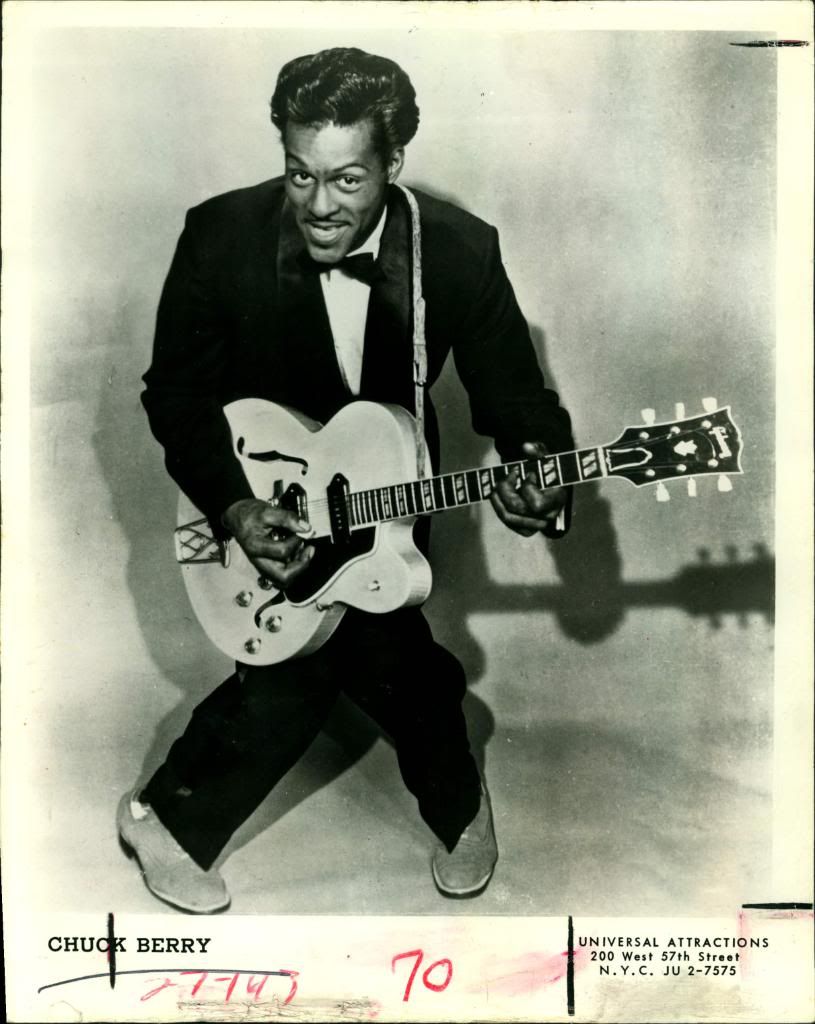
Chuck Berry 1971.JPG
"Chuck Berry 1971" by Universal Attractions (management) - eBay item photo front photo back. Licensed under Public Domain via Wikimedia Commons.
Bystanders playing roles, cover songs, digital auditions to join the group, possibly secretly authorized by Steffi Humboldt as Dr. Farthington...that could be pretty funny.

It actually might be a way to have a contemporary Concert for Iceland. Maybe it all appears to be arranged by the Arthur White camp. Maybe we could bring back the idea of Augustine White. Maybe he, some web winners, and the angry remnants of the original Sweet World use a new Concert for Iceland as revenge against Arthur.

I've also been thinking about the lost storyline of the original Sweet World trapped in Japan, Arthur's kids, and Rystyy Kryyztyylz (sic).

We have some generational juxtaposition going on with Carlton vs. Steffi (the 70's cult becomes the Internet) and the two generations of Joe Lazari.

But it would be fun since we have the Witkowskis as the problematic American nuclear family to deal with the Whites as the deconstructed postmodern family. (There might also be an opportunity to contrast musicians "back when music meant something" to the technicians of today).

Anyway, I'm into this notion that the original Sweet World lives to spite Arthur but isn't quite bright enough or resourceful enough to do so, and that Augustine is basically bent on revenge, too, which leads to Concert for Iceland II featuring A. White and the Original Sweet World. I also like the idea that two members of The Sweet World form Beefoven with Rystyy Kryyztyylz and later change their appearances to join the cult and the band Apotheosis, not out of love for Farthington but to plot revenge against Arthur. Perhaps Arthur never even knew their names in The Sweet World.

Also, I'd be really happy if Beefoven's album were called Roll Over.


Wednesday, August 20, 2014

"Catapulted" into the Religious Sphere

The following is an excerpt of an email sent from Art to Will on 4 August 2014.

As for messages getting buried: That was one of the issues that I thought would get handled by taking the emphasis off mimesis and taking a diegetical approach--or at least more diegetical. We can talk about the story just like we do in our emails and, by extension, the blog. I was actually of the opinion we should go totally diegesis in our podcast. I think it lends itself to our strengths of telling not showing and it is a classical, Platonic solution to the problem of having the opposite of our desired, edifying effect on our audience.

Where is Jimi Hendrix located?
In deference to St. Augustine, I'm going to disagree that the ethical sphere is absurd and banal (I'm of the opinion that Kierkegaard got his ideas for the spheres of existence from Augustine's City of God). Augustine just betrays too much admiration for the highly ethical Romans he uses as examples of how close some pagans came to the kingdom. I would say that most churchgoers are actually in the aesthetic realm trying to work around or bargain with the ethical when absolutely necessary. The ethical realm is characterized by a willingness to die rather than to sin. I think ethical is rightly considered the realm from which one is "catapulted" into the religious sphere.

So where are Jimi and Arthur and prostitutes and Carlton Farthington located? It might be difficult to locate. But modern artists and would-be mystics might consider the ethical sphere impossible to stomach without the more complete revelation of the religious. They are different than the aesthetic types who just want to burn their eyes out on Netflix every weekend and buy a cottage someday.

For this reason, I also think Arthur would have picked up on the unnaturalness in Lena's charitable activities. The Sweet World is way bigger than that. It wouldn't feel as natural as breathing to him, but it might have been a womb-like place where he found some nourishment.

Monday, August 18, 2014

Buried Under the Plot Twists

The following is an excerpt of an email sent from Will to Art on 4 August 2014.

Thomas Merton at his hermitage
So Arthur is a child in the embrace of his mother' Old World Catholicism which feeds him a rich supernatural view of the world, plus his mom obsessively serves the poor (although in a misguided way), which makes Arthur feel that service to the poor is as natural as breathing, which it is in the Sweet World.

Then Arthur is an adolescent in a post-Vatican II world that replaces the organs with acoustic guitars and pianos, flips the altar around, replaces oil paintings and stained glass with felt banners, the stone and marble with drywall and pine.

Then in his autumn years, the Church becomes an extension of people's right-wing political affiliations! Meanwhile, angels are singing the triumph of Christ, demons are fleeing in terror and trying to knock as many of us over as they can as they are rounded up, Jesus is inviting us to walk on water, etc!

I've been looking at the project in terms of what it should say to non-Catholics, but you have nailed what it should say to Catholics! So many of us are Will Witkowskis, viewing our faith like it's something we ought to do but not absolutely necessary to live good worldly lives, like saving 10% toward retirement, exercising, or flossing. We don't get that God is our life itself, not the bonus prize at the end of an esteemed career and well-funded retirement.

By the way, regarding this:
Maybe we visit Arthur in a small hermitage. Maybe he has even become a priest through some special dispensation (he wouldn't be able to get through any of the heavy theological study--I'm sure there is some example of this in history).
How about St. John Vianney, whose feast day is today?! We picked a good day to pray the daily readings!

So how do we keep these messages in the right places in the story so that they aren't buried under the the plot twists or spelled out by some lame chorus? I don't know that the messages peek out clearly in every podcast, but prolonged exposure should clarify them.

I'm inclined to say that Joe Lazarus, Sr. and Jr. are the mechanisms. That Joe Sr. is destroyed by his pursuit of God (as Arthur experiences Him) and that Joe Jr. is saved by it.

Also, Joe Jr.'s parents are inversions of Arthur's. Joe Sr. was an absentee dad where Stan was about moving heaven and earth for the misunderstood good of his family. Joe's mom is what Fr. Joe calls "The Frozen Chosen," where Arthur's mom is an activist.

I also think back to Kierkegaard. In some ways, the religious sphere is closer to the aesthetic sphere than the moral sphere. Maybe the story can reach people in the aesthetic who long for the truth and beauty only the religious sphere can offer. And maybe Will demonstrates the absurdity and banality of the moral sphere.

Saturday, June 7, 2014

The History of Arthur White: The Sweet World

The following is an excerpt of an email sent from Will to Art on 2 January 2013.

In the early seventies, music was evolving at a rapid pace, and both Arthur and Will understood that Arthur White and The Five Wits' brand of hard-rocking Motown covers were too old-fashioned.

Arthur was heavily influenced by the new directions of Marvin Gaye, Stevie Wonder, and Curtis Mayfield. Will just knew it was time for something new, and that the Five Wits weren't the right vehicle for Arthur's songwriting anyways. Luckily, the other Wits were off to college or were too busy with their assembly line jobs and wished Arthur luck. Arthur and Will put out ads and assembled the new group, which they both decided they should call The Sweet World of Arthur White. Arthur liked the name because all he had ever wanted to do was tell the story of The Sweet World, which still occupied his dreams even if it wasn't as vibrant as it used to be. Will liked the name because it was a big middle finger to everyone who had ever messed with his brother, and because it capitalized on the success of the Arthur White brand.

The Sweet World combined Arthur's Motown influences with psychedelic and folk elements plus Arthur's mystical lyrics. The band was a huge local smash and Will made getting the band to California, cutting a demo, and getting signed a one-year goal. Will worked hard on this goal and succeeded, but he did so with a type of single-mindedness that kept him from being an empathetic brother. The more the band worked, the more Arthur lost his mystical connection to the real Sweet World. That, coupled with the loss of his mother, led him to get married too early to Agniesczka, a childhood friend  Arthur reconnected with on tour.

Unfortunately, Arthur idealized her for the child she used to be, just as he idealized his own childhood as a way of retreating from the miseries of middle school. One night Arthur touched a woman during one of the Sweet World's more intense numbers, and she had a mystical experience that unnerved him. Will made Arthur make touching a woman's cheek and singing directly to her part of the act, and the sexual-mystical-spiritual confusion that resulted terrified Arthur and also drove him to an early marriage so that he could stay chaste if not celibate.

On top of all that, The Sweet World wasn't like the Five Wits: it hadn't evolved out of the friendship of neighborhood buddies and family members, but out of a search for great players. Those great players brought a lot of habits with them that kept Arthur distant from them. He was always afraid of guys because of the bullying and never was very good at making friends with them and, on top of that, it seemed like the only way to spend time with the guys on their terms was to chase girls and party. By the time the first album was recorded, Arthur was in a steady pattern of running from the band to Will, from Will to Agniesczka and the kids, from Agniesczka and the kids into prayer, from prayer into songwriting, and so on.  Every part of Arthur's life attracted him and terrified him, every part was sanctuary and cause to flee.

Then, a bunch of horrible stuff happened all at once.

Thursday, June 5, 2014

The History of Arthur White: "Saint Arthur"

The following is an excerpt of an email sent from Will to Art on 2 January 2013.

Arthur was more like his mother.

His dad died when Arthur was very young so he barely knew him, but even still, everyone loved Will for being like his dad and everyone loved Arthur for being like his mother. While Will was out roughnecking it, Arthur followed his mother around town. They went to mass every day, then went around making Hamtramck a beautiful place. They planted flowers, took meals to shut ins, brought neighbors cookies, babysat for free or slipped money to people who were down on their luck and helped them find work. The boys in the neighborhood flocked to Will; the girls flocked to Arthur. When their pets were sick, Arthur would pray over the animals and lay hands on them and they would be all better. They loved to hear him tell stories of The Sweet World...a garden of delights he could go to in his mind where a beautiful woman taught him songs, played games with him, prayed with him, and showed him her baby. Arthur got the nickname "Saint Arthur."

Arthur had a very happy early childhood, but things got bad for him in middle school. The sixties were rough times for Detroit and, in the years following Stan's death, people forgot all the good things the Witkowskis had done for the community and started to resent their comfort. Stan's brother-in-law Anthony didn't have the same touch with the workers as Stan had, and Will frequently found himself having to straighten out conflicts in the company. A round of lay-offs followed the '67 riots as businesses pulled out of the area, and, even though Anthony and Will managed not to let anybody go, people blamed Witkowski and Sons for not hiring during a time of such high unemployment. Stan, they said, would have hired them. A lot of the community resentment fell on Saint Arthur: as his classmates' parents complained about the Witkowskis at the dinner table, his classmates felt justified in avenging their parents' misfortunes by going after Arthur. He was an easy target: he was the only kid in Catholic school who not only enjoyed going to daily mass, but cried during it. The Sweet World stories were fine when Arthur was a kid, but what business did a fourteen-year-old have telling them? They beat Arthur mercilessly.

Will beat up anybody who came after Arthur, but since he was in high school and Arthur was in middle school, and since he spent so much time working, he couldn't do much to protect Arthur. He tried to teach Arthur to fight, but even though Arthur wasn't weak, he just had no instincts to even defend himself, much less hurt another person. After a particularly bad beating, Will sat Arthur down and told him that if he would have to stop being such an easy target with all the talk of the Sweet World, the tears during mass, the mama's boy routine, the whole "Saint Arthur" thing. Arthur didn't want to let go of the Sweet World, but he trusted Will. Lena knew that Arthur couldn't just stop being Arthur and blamed herself for being such a feminine influence on Arthur and she asked Will to let Arthur play in Will's band, The Five Wits. Even though Will was a little nervous about making his band uncool, he saw the wisdom in his mother's thinking. Plus, he knew his brother could sing and play organ well, and even if he couldn't, Will wasn't one to back down from any fights that might pop up over family.

The experiment went really, really well.

Friday, May 30, 2014

Cataclysmic Changes (Part 1 of 3)

The following is an excerpt of an email sent from Will to Art on 10 April 2014.


I was thinking about the idea of cataclysmic changes and the Concert for Iceland while watching a documentary about backup singers that had some reflections on the Concert for Bangladesh.

I started thinking about Farthington, and it dawned on me that maybe he isn't just using Arthur for his talent, but for his spiritual gifts...that maybe the number one thing he wants is to somehow siphon Arthur's power from him.  Whether that can actually be done is unclear to me and I don't want to put anything rooted in magic rather than Catholicism out there, but I wonder about a few possibilities:
  1. Is it not just the electroshock, but some sort of power-siphoning that damages Arthur?
  2. Do the cataclysmic changes happen on some level?  Does Farthington somehow use Arthur's power to bring about some horrible power that shapes the 80's?  Some sort of void?  Maybe something electronic?
  3. If so, does Arthur know?  Does he feel guilt?
I worry about Arthur coming off as too much of a vegetable.  He may appear to be one at times, but his interior life should nearly always be far more dramatic than any other character's.

His natural state should be life in the Sweet World--joy in God's garden with Mary--but being torn from that Garden, seduced away from it, weaving in and out of it, being convinced that it isn't the highest reality of his experiences, all of these things and more should be sources of inexplicable drama.

Arthur should be inexplicable because he is tied into the inexplicable.  The appeal of both Will and Farthington--the American dream and cultish psychospiritual babble--is that both offer some order to the inexplicable.

Will reduces reality to a very simple code, and Farthington offers answers, even if they are grounded in nothing.  The appeal of both Joe Lazaruses is their ability to catch glimpses of the Sweet World that Arthur lives in, to share in that beauty on even a small level with Arthur as friends, and to help communicate what Arthur sees to the rest of the world.

Monday, May 19, 2014

Sitting on Several of the Best Albums of the Seventies

Marshall McLuhan
The following is an excerpt of an email sent from Will to Art on 19 March 2014.

McLuhan: "Do you know what the satellite does to you? As an environment, when it goes around the planet? Its a proscenium arch. It turns the planet into a stage, makes you want to be an actor."

I feel like the architecture (if we can call something so destabilized architecture!) to make the project authentically postmodern is all in place...thanks for all the hard work!

Now we just need to give it to God.

I've been thinking about maybe writing a few, for lack of a better term, gags.

One is a Tiger Beat magazine profile of the young Arthur. I think the idea of Arthur saying anything that, say, Chachi or David Cassidy might say is absolutely hilarious.  So is the idea that Will or a Tiger Beat writer would have just ended up making everything up.  I'm also curious to see if my sister might be able to take a picture of you from high school and turn it into a Tiger Beat profile.

I'm also thinking about revisiting The Sweet World children's show and maybe making Arthur's children's book.  It's probably a decent time for me to work on artifacts.  I feel like the basic frame of the story is solid enough for now.  The blog demands some looseness to it, we've got a solid enough big picture to guide us, and we don't have any pressing need to put out the big picture epic in any form.

Your recent blog entries discussing songs reinforces this itch I have to devote time to our music.

I'd like to shoot for an album...any era, but in the mean time, if you want to play with some more Garage Band stuff, that would be awesome.  I really do feel that the most accessible key for the audience to unlock the world of Arthur White is the music.  I think you underplay how good it is...I've said it before, but I think you are sitting on several of the best albums of the seventies.

We're living in the age of the un-/underdiscovered icon and we've got not just an epic to unleash but an entire culture...we've got our message, our cultural relevance, a lifetime's worth of artistic work lying in wait if we can ever get the enthusiasm and support for the project underway, and I think we've done the right thing in making the project enormous and unmanageable rather than containable and shallow.

But the music is always going to be the best part and the way in.

The three of us will always go into these eccentric intellectual and theoretical places, but the music hits people of any sort of bent. It's what breathes life into the characters, too, and the story, for that matter.

In the music is God working through Arthur and Arthur's struggle to respond to his calling, Will's struggle to serve his family and channel Arthur's art into the fulfillment of the American dream--it's the candle that attracts the moth of Joe Lazarus, Sr. and the key that helps Joe, Jr. atone with his father's legacy, the prize that attracts Dr. Carlton Farthington, and the gift that God gave the world.

In some ways, every character is defined by that fact--how do we deal with this gift?

And that question may be the key for my figuring out how to take something so postmodern and keep it in the spirit of a morality play...no matter how outlandish we get or where other authors take the story, there will always be a set of foils dealing with the question of how we handle a blessing, not to mention the three of us.

And there will always be the problem that postmodern people in general don't recognize blessings anymore.

We might be able to help sharpen a dying instinct.

Tuesday, March 18, 2014

An Early Chronology of Songs (Part 1 of 2)

The following is an excerpt of an email sent from Art to Will on 26 August 2012.

Okay, here's a tentative chronology of some songs with the bands that played them underlined:

The Sweet World of Arthur White:

This is the far-off gaze on the object of love.  Some problems, but still highly idealized.  Would corresponds to the novice stage of religious life, courtship phase of romantic life.
  • Could I Be The One?
  • Message of Love
  • Head Over Heels
  • The Treatment
  • The Guarantee
  • Give You a Taste
Next seems to come some kind of commitment phase, profession of vows, married or religious. Continues with previous list of songs, but these feature more of a spiritual/existential horizon.  This is also a bit of a "Yoko" phase for the Sweet World as Arthur disappears into family life a bit more.   "Hands Reach Through the Haze" is written for his first daughter.  This tendency toward isolation--while relatively healthy and appropriate in the context of marriage and family--will become disordered later on as those things fall apart.
  • Bird's Eye View
  • One and Only
  • Hands Reach Through the Haze
After some initial success, he is approached by Serbian-American filmmaker Bohdan Damien...(can't remember his last name), and writes a partial score for the never-released movie Street Heat.  I like the thought that Arthur White, after the movie's demise, releasing the music under the album name: Music That I Wrote for the Movie Street Heat.
  • Sweet World Intro
  • Sweet World Genesis
  • Rocketship
Probably would name these songs something different for the movie, but when the movie didn't happen, that's what I ended up calling them.  Maybe "Theme from Street Heat" or "Arthur Plays It Cool" would suffice.

Monday, March 17, 2014

Questions for Will

The following is excerpted from a December 2012 email exchange between Will and Art.

What role does Agniesczka play?  
I don't foresee getting an actress to play her.  At most, we might need some old photographs, but even those could be of her and the kids.   
In the old days, Arthur wasn't around much or there wasn't any reason for her to end up in the band footage, so she is mostly just alluded to in the narrative.  In the present day, she is dead or otherwise gone.   
I do hope for a day when we turn the whole story into a musical; at that point, neither of us will play our roles, so we can develop her role more fully then--and that of Will's girlfriend Linda--when there's no need for us to do the acting.  Will spends most of his life in the future and Arthur has a really tenuous relationship with chronological time, so I don't see either of them as big picture takers.
Why would Will use marriage to control Arthur?  
Will is torn between his Polish roots and his New World roots.   
His New World roots can only think in terms of being a swinging single: initially, he tempts Arthur into forming The Sweet World through women.   
He feels guilty about that when he sees how that path nearly destroyed him, so he turns to the Old World alternative: marriage. Will can't think in terms of celibacy, which is what Arthur really needs.  But if Arthur becomes a monk or hermit, he can't be a rock star.  Plus, celibacy just seems to weird and unnatural to a modern man like Will.   
So Will wants to make amends (here again is how we keep Will from wearing a black top hat and twirling his mustache).  Will took a vow that he would make his brother a star. His approach in the Sweet World failed, so he tries another approach, grounded in a very Polish vision of stability (marriage and church) as well as a 70's vision (psychology, counseling, support groups, settling down).   
I think Will feels that if Arthur has stability at home, he can compartmentalize and be a husband and father by day and a rock star by night.  Initially, Arthur sings about domestic bliss, but soon he feels called to subjects like confessing his guilt and the state of America's soul.   
As Arthur comes closer to singing about the things he feels called to sing about, his marriage, band, and relationship with his brother deteriorate.  Will sees everything that he tried to build for Arthur falling apart and resents him for it.  Will can only think in terms of real-world responsibilities, and here's Arthur chasing ghosts while the woods are burning.  
The ECT is a combination of revenge, resentment, a quest for control, love for his brother, and fear that his brother may be right and that everything Will has pursued is wrong. 
Will's hamartia is a type of misguided nobility.  If you want to go as far as a lobotomy, we can; I think he does need to be permanently scarred from his institutionalization, but ECT might be enough.  The treatment severs his ability to easily distinguish between past, present, and future, real and mystical, word and deed.  His capacity to distinguish what is reality the way other people perceive it and what is his own mystical connection to God was never strong to begin with, but it's gone now.   
Will is too salt of the earth to get that, and he just sees crazy.  Joe will figure it out, though, and help Arthur reenter the world.

Tuesday, March 11, 2014

Concert for Iceland Update

The following is an excerpt of a 29 December 2013 email sent from Art to Will and Joe.

I want to start the re-recording process with songs from Concert for Iceland, which I see as Arthur White's last show under his full powers.

Some of the material relates Arthur's marital and mental breakdown, but also some hopeful songs in which he is clearly breaking free from the sham promises of Carlton Farthington.  I'm not sure Arthur even made it to Iceland: this may have been when Will staged his definitive intervention.  Indeed, in the song "Iceland," Arthur seemed to be under the impression that Iceland is made entirely of ice (thus rendering the volcanic explosion even more devastating in his mind).  But he was at least ready to go and not just for the concert.

The true object of the trip is explained in Farthington's Principles of Theory.

The other exciting possibility in this stage is the rediscovery of famed guitarist Rustyy Kryystyylz, who was planning on playing the benefit concert with Arthur.  This was widely seen as a potential new creative collaboration after the dissolution of The Sweet World.

A funny show would be Arthur and Rustyy playing along with a karaoke machine, dramatizing just how both had fallen after the failed benefit.

Tuesday, February 18, 2014

What Comes Out is Pure Prophesy

The following is an excerpt of a 19 December 2012 email sent from Art to Will.

I agree with you that the other characters need to be developed, to be protagonists in their own right.

I may have less insight into them because their personas derive (at least in part) from you and Joe.  Also, having written more poetry and songs than fiction, I'm not as adept at juggling multiple characters in a large, expansive plot as you are.

The only thing that I'm trying to represent is my sense of my own character and the songs, many of which I haven't had a chance to play for you yet.  I don't think it's that big of a difference of opinion philosophically.

Actually, it may be less philosophical as it is the organization of events.  

Without getting into super long paragraphs again, I just think that the marriage/children have to come first (toward the end of the Sweet World era) for the progression of songs to make sense.

Then losing the band-->short stint with Apotheosis-->losing wife, kids-->joining a cult, getting out of the cult-->getting electroconvulsed-->getting propped back up by Will to front Brand New Life.  

Brand New Life is ironic because for Will it's just an attempt to do definitively what he has been trying to do all along: whitewash all the mystic mumbo-jumbo and bring Arthur back down to the Kierkegaardian aesthetic sphere where he can be made profitable.  

The irony is that this "final solution" actually does the exact opposite, making Brand New Life a true resurrection of the original Arthur, catapulting him definitively into the religious sphere, never to descend again.  

Now, in spite of (because of?) his destroyed mental state, he speaks prophetic words that cut like a double-edged sword.  He's kind of like Dave Bowman has become by the movie 2010.  Unlike Dave, however, Arthur may be thoroughly broken on a human level--mental anguish can still be occurring.

But when he sings, what comes out is pure prophesy.

Saturday, February 15, 2014

Who is Arthur White? (Part 1 of 2)

The following was written in January 2007 to introduce potential new band members to the origins and history of the Arthur White concept.

Arthur White was born in 1997 out of the ashes of a torrid, ill-fated love affair.  The first few songs written in this style were obsessive attempts to rekindle this romance, if only in some poetical sense.  At this time, I was playing organ in Le Triggers [sic] and living in our practice space in the Performance Center (which, I've heard, has since mysteriously burnt to the ground).  No one could make much sense of Arthur White since we were an indie rock band and there were few examples of this style of music in the Ann Arbor-Detroit scene or anywhere else for that matter.

This is not to say, however, that there was an absence of prototypes influencing me.  In fact, a longtime affinity for R&B had been growing and fusing with a newfound love of bossa nova.  Marvin Gaye, Donny Hathaway, The Main Ingredient, The Dells, The Moments, and The Dramatics melded with the likes of Brazil '66, Antonio Carlos Jobim, João and Astrud Gilberto, Stan Getz, and Herbie Mann.

The name Arthur White first came about as shorthand between band members, e.g. "Are we having an Arthur White practice today?" scribbled on a post-it note and affixed to the door of our practice space.  The reference was to an apparent similarity between my voice and Barry White's.  Later, a band member's dad provided us with the name of our first band--"The Sweet World of Arthur White"--taking inspiration from yet another musically complex individual, Arthur Brown, and his band, "The Crazy World of Arthur Brown."

These archetypes intermingle in innumerable ways and are continually contemplated in the mind and music of Arthur White.  As much as anything, Marvin Gaye's album, Here, My Dear--with its achingly beautiful mediation on his marriage and subsequent split up--provides a psychic center and template for many of the songs.  Barry White's metaphysical "you" also finds expression in Arthur White: love songs are deepened to the point of becoming analogical expressions of desire for divine union, as in St. John of the Cross's Dark Night of the Soul.